The Fathers of the Church regularly practiced the spiritual interpretation of Scripture, and to this day the Church calls us and teaches us how to do the same (CCC 108-18). Spiritual interpretation is the practice of reading and interpreting sacred Scripture in the same Spirit in which it was written in order to understand all things in light of the mystery of Christ. Spiritual interpretation increases our knowledge and love of the Lord and serves our union with him. It leads to our divinization by grace. In a recent blogpost, my confrere Father Ignatius Schweitzer called for a renewal of spiritual exegesis. Toward that end, I offer a meditation on the visit of the Queen of Sheba to King Solomon in 1 Kings 10:1-10.
1 The queen of Sheba, having heard a report of Solomon’s fame, came to test him with subtle questions.
Solomon is a type. He stands for Jesus Christ. The Queen of Sheba is a type too. She stands for the soul seeking wisdom. When we consider Solomon and the queen of Sheba accordingly, we will catch a glimpse of the moral sense of the whole passage. Just as the Queen of Sheba departed from her land, journeyed to Solomon, and found in him the wisdom she desired, so you and I are called to depart from our sin, our attachments, and our turbulent impulses, journey to Jesus Christ in faith and hope, and find in him all the wisdom our hearts desire.
2 She arrived in Jerusalem with a very numerous retinue, and with camels bearing spices, a large amount of gold, and precious stones. She came to Solomon and spoke to him about everything that she had on her mind.
The Queen of Sheba brought spices, gold, and precious stones, and they are like all our gifts of nature and grace. Later, in verse 10, she will make of them a gift to Solomon. When you and I come before the true Solomon – Jesus Christ – do we come with all our gifts of nature and grace in order to lay them at his feet?
She came planning to speak to Solomon about everything on her mind. Do we speak with the Lord Jesus about everything on our minds? It might seem impossible to tell him everything in one period of prayer or even in a lifetime of prayer, but the point is to hide nothing. Let us lay our minds open to the Lord. Let us ask him our questions with the simplicity of children. Other translations say she “questioned him on every subject in which she was interested.” Her act of questioning is like our meditation in faith. When we meditate, do we raise questions, put them to the Lord, and confidently expect answers? The next verse takes up the question further.
3 King Solomon explained everything she asked about, and there was nothing so obscure that the king could not explain it to her.
Just as Solomon explained everything she asked about, so the Lord Jesus will do for us. The Fathers of the Church expected the Lord to give them light and understanding in prayer, especially when they were reading Scripture, but do we? We are not talking about extraordinary revelations, locutions, visions, etc., but the ordinary lights and insights God bestows on our minds by grace. His ordinary lights and insights often come in the form of simple realizations, new understandings, or a new clarity of mind. His ordinary lights and insights can form a whole new perspective on things, either gradually or instantly, and a new tranquility in looking on matters in a new way. Although God commonly gives such lights and insights, especially through the Spirit’s gifts of understanding and knowledge, God expects to ask for them as well.
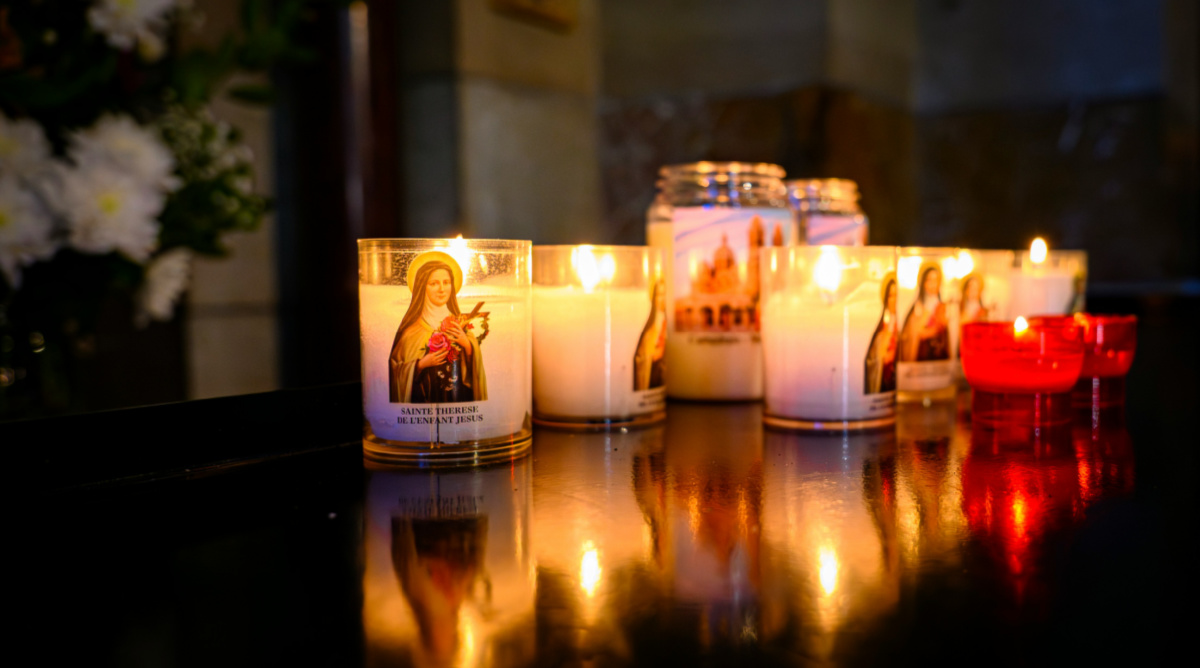
Saint Therese of Lisieux teaches us to be confident in God to the point of audacity. We should expect the Lord Jesus to light things up for us – especially the mysteries of faith and the decisions of our lives – just as Solomon answered all the questions of the Queen of Sheba. The key is to pray humbly, confidently, and persistently for the light of Christ. There is nothing too obscure for the Lord to explain. For in him “are hidden all the treasures of wisdom and knowledge” (Col. 2:3).
4-5 When the queen of Sheba witnessed Solomon’s great wisdom, the house he had built, the food at his table, the seating of his ministers, the attendance and dress of his waiters, his servers, and the burnt offerings he offered in the house of the Lord, it took her breath away.
Now we look upwards to heaven for an anagogical understanding. The great wisdom of Solomon is like the eternal Wisdom of God. The house Solomon built is like the Father’s House on high in the heavenly places. The food at Solomon’s table is like the true bread from heaven – every word coming forth from the mouth of God. The seating of Solomon’s ministers is like the whole host of hierarchs gathered in heaven. What will it be like in the end to behold every holy Pope, every holy Bishop, every holy Priest, and every holy Deacon gathered together from all the ages and all parts of the earth into the one holy Church of God in Light? The attendance and dress of the waiters, too, shall be resplendent. For the waiters will be all the elect, and their dress shall be white garments washed in the blood of the Lamb (Rev. 7:14). Their attendance, too, shall be awe-inspiring. Gone shall be the days of felt tension between the active and contemplative sides of life. Our inner Martha and inner Mary shall be at completely at peace within each one of us. The eyes of our hearts shall be rapt in perpetual contemplation of the divine Light even as we move about in our glorified bodies. As for the burnt offerings in the temple of Solomon, well, there shall be only one sacrifice in the Church of heaven. “Into your hands Lord, I commend my spirit,” is what we shall say. It will be a true gift of ourselves to the Father offered up all at once and forever with our eternal High Priest Jesus Christ in the fire of the Holy Spirit. Shall we not all be breathless at the sight?
6-7 “The report I heard in my country about your deeds and your wisdom is true,” she told the king. “I did not believe the report until I came and saw with my own eyes that not even the half had been told me. Your wisdom and prosperity surpass the report I heard.
Just as the Queen of Sheba heard the news of Solomon, so you and I have heard the news of Jesus Christ. Our faith has come through hearing (Rom. 10:17), and God has given us the grace of faith so that we might make our way to knowing the Lord in a better way than by faith alone. The Queen of Sheba came to see for herself, and God calls us to make the journey to contemplative prayer. For when you and I receive the grace of contemplative prayer, we come to know the Lord not by hearing alone, but by tasting and seeing the goodness of the Lord for ourselves – experiencing him in Love. When we do, we realize for ourselves that all the words of preaching and teaching fall short of capturing completely the greatness of our God.
8 Happy are your servants, happy these ministers of yours, who stand before you always and listen to your wisdom.
What is the proper response to the Jesus Christ? To stand before him day and night listening to Wisdom. “I want to spend my life in listening to you,” said Saint Elizabeth of the Trinity, “I want to become wholly teachable, that I may learn all from you.” Although it is not possible to consider God continuously in this life, let us at least be mindful of God to the fullest extent we can by the help of his grace. In this way, our hearts shall be readied for perpetual contemplation up above.
9 Blessed be the Lord, your God, who has been pleased to place you on the throne of Israel. In his enduring love for Israel, the Lord has made you king to carry out judgment and justice.”
God has placed Jesus Christ on the throne, and Jesus Christ has set his seal on your heart and mine in our baptism. For we are the new Israel by grace, and his love for us is enduring. Now it is for us to surrender to his lead in everything and return love for love received insofar as it is possible. How?
10 Then she gave the king one hundred and twenty gold talents, a very large quantity of spices, and precious stones. Never again did anyone bring such an abundance of spices as the queen of Sheba gave to King Solomon.
God has given us his everything in Jesus Christ. Now it is for us to give him our everything too – all our gifts of nature and grace. Let us lay it all at his feet as a gift of love to him – our lives, our hearts, our all. So long as we continue to do so, then in the end we shall know a generosity far greater than what the Queen of Sheba showed to Solomon. We shall know the generosity of God towards us, and we shall experience the abundance of eternal joy.
__________________________________________________
Image: Lucas de Heere, Public domain, via Wikimedia Commons