A Reflection from “Arise” by Laura Bedingfeld
Arise, O Lord!
Alongside the relatively few testimonies to hope in bodily resurrection in the Old Testament, resurrection symbolism is frequently present in psalms and prophecies, as the prayerful expression of hope born in adversity and of gratitude for the Lord’s redeeming love.
Be gracious to me, O Lord! See my affliction from those who hate me, O you who lift me up from the gates of death, that I may recount all your praises, that in the gates of the daughter of Zion I may rejoice in your salvation. (Ps. 9:13–14)
I will extol you, O Lord, for you have drawn me up and have not let my foes rejoice over me.O Lord my God, I cried to you for help, and you have healed me. O Lord, you have brought up my soul from Sheol; you restored me to life from among those who go down to the pit. (Ps. 30:1–3)
But you, O Lord, be gracious to me, and raise me up, that I may repay them! By this I know that you delight in me: my enemy will not shout in triumph over me. (Ps. 41:10–11)
Your righteousness, O God, reaches the high heavens. You who have done great things, O God, who is like you? You who have made me see many troubles and calamities will revive me again; from the depths of the earth you will bring me up again. (Ps. 71:19–20)
Bless the Lord, O my soul, and all that is within me, bless his holy name! Bless the Lord, O my soul, and forget not all his benefits, who forgives all your iniquity, who heals all your diseases, who redeems your life from the pit, who crowns you with steadfast love and mercy. (Ps. 103:1–4)
Come, let us return to the Lord; for he has torn, that he may heal us; he has stricken, and he will bind us up. After two days he will revive us; on the third day he will raise us up, that we may live before him. (Hos. 6:1–2)
I called to the Lord, out of my distress, and he answered me; out of the belly of Sheol I cried, and thou didst hear my voice. . . . I went down to the land whose bars closed upon me for ever; yet thou didst bring up my life from the Pit, O Lord my God. ( Jon. 2:2, 6)
Many other psalms echo the refrain “Arise, O Lord!” invoking the God who rises up to deliver, to vindicate divine justice, and to console the oppressed.
Arise, O Lord! Save me, O my God! (Ps. 3:7)
Arise, O Lord, in your anger; lift yourself up against the fury of my enemies. (Ps. 7:6)
Arise, O Lord! Let not man prevail; let the nations be judged before you! (Ps. 9:19)
Arise, O Lord; O God, lift up your hand; forget not the afflicted. (Ps. 10:12)
Arise, O Lord! Confront him, subdue him! Deliver my soul from the wicked! (Ps. 17:13)
Contend, O Lord, with those who contend with me; fight against those who fight against me! Take hold of shield and buckler and rise for my help! (Ps. 35:1–2)
Arise, O God, defend your cause; remember how the foolish scoff at you all the day. (Ps. 74:22)
Arise, O God, judge the earth; for you shall inherit all the nations! (Ps. 82:8)
The psalmist’s imagery of the Lord rising to save Israel echoes Moses’ prayer each time the Ark of the Covenant of the Lord set out through the desert at the head of the Chosen People: “Arise, O Lord, and let thy enemies be scattered; and let them that hate thee flee before thee” (Num. 10:35). Rising to save is an act of divine justice and judgment. It is also a manifestation of the Lord’s steadfast love and forgiveness when Israel has been brought low by its own infidelities:
Awake! Why are you sleeping, O Lord?
Rouse yourself! Do not reject us forever!
Why do you hide your face?
Why do you forget our affliction and oppression?
For our soul is bowed down to the dust;
our belly clings to the ground.
Rise up; come to our help!
Redeem us for the sake of your steadfast love! (Ps. 44:23–26)
When read in the context of these supplications, the prophecies of Isaiah resonate as the Lord’s resurrection response: “‘Now I will arise,’ says the Lord, ‘now I will lift myself up, now I will be exalted’” (33:10).
Ultimately, the Holy City, too, will be enveloped in the grace of the Lord’s rising, as is each one of our souls by the grace of baptism:
Arise, shine; for your light has come, and the glory of the Lord has risen upon you. For behold, darkness will cover the earth, and thick darkness the peoples, but the Lord will arise upon you, and his glory will be seen upon you. (60:1–2)
Awake, awake, put on your strength, O Zion; put on your beautiful garments, O Jerusalem, the holy city. . . . Shake yourself from the dust, arise, O captive Jerusalem. (52:1–2)
As these examples show, resurrection comes to be synonymous in the symbolism of psalmody and prophecy with powerful divine intervention and indomitable steadfast love. It speaks of renewed life and light granted to sinners after merited chastisement or the apparent victory of evil: “You, O Lord, are enthroned forever; you are remembered throughout all generations. You will arise and have pity on Zion; it is the time to favor her; the appointed time has come. For your servants hold her stones dear and have pity on her dust” (Ps. 102:12–14). Both he who arises to forgive and we who arise forgiven are witnesses to the power of resurrection.
Throughout the formative years of Israel’s hope, the Lord’s mercy to sinners was expressed in a particularly concrete way by “raising up” instruments of salvation in their midst. Whether prophet, judge, warrior, priest, or king, the Lord’s anointed deliverer was raised up not only to save them from their enemies but to bring them more fully into covenant fidelity.
I will raise up for them a prophet like you [Moses] from among their brethren; and I will put my words in his mouth, and he shall speak to them all that I command him. (Deut. 18:18)
Whenever the Lord raised up judges for them, the Lord was with the judge, and he saved them from the hand of their enemies all the days of the judge. (Judg. 2:18)
But when the people of Israel cried to the Lord, the Lord raised up a deliverer for the people of Israel, who delivered them. (Judg. 3:9)
And I will raise up for myself a faithful priest, who shall do according to what is in my heart and in my mind; and I will build him a sure house. (1 Sam. 2:35)
When your [David’s] days are fulfilled and you lie down with your fathers, I will raise up your offspring after you, who shall come forth from your body, and I will establish his kingdom. (2 Sam. 7:12)
Through this recurrent use of resurrection symbolism, the language of Scripture subtly fashions the hope of the Chosen People, sketching the contours of the Anointed who would someday be raised up from among them for their salvation.
In the meantime, the Lord’s call to “arise” echoes from generation to generation—to Abraham (Gen. 13:17), Lot (Gen. 19:15), Hagar (Gen. 21:18), Jacob (Gen. 35:1), Moses (Deut. 10:11), Joshua (Josh. 1:2), Gideon (Judg. 7:9), Samuel (1 Sam. 16:12), David (1 Sam. 23:4), Elijah (1 Kings 19:7), Jeremiah (18:2), Ezekiel (3:22), Jonah (3:2), Micah (2:10)—awakening within those who accept it a readiness to accomplish his will and renewed vigor to live in his presence.
In each of these instances, “arise” calls forth a unique courage, because in each it encapsulates a unique mission. The same is true in our own lives. Whatever our state in life or mission, whatever situation might have us prostrate on the ground or paralyzed in fear, the Risen Lord calls us to a wholly personal share in his resurrection. In the words of the Song of Songs: “Arise, my love, my fair one, and come” (2:10).
+
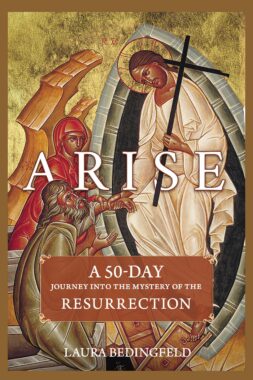
This article on resurrection symbolism is adapted from the book Arise by Laura Bedingfeld which is available from Sophia Institute Press.
Art for this post on a reflection from Arise: cover used with permission; Photo used in accordance with Fair Use practices.