A Reflection from “The Power of the Rosary” by Gabriel Castillo
The apparition of Our Lady of Fatima is the most investigated Catholic event in Church history, with the most witnesses and highest level of approval. The site has been visited multiple times by different popes and has a feast on the universal calendar. Two of the three seers, Sts. Francisco and Jacinta, were canonized as saints in 2017; St. Jacinta’s body, exhumed fifteen years after her death, was found to be incorrupt.
The “miracle of the sun,” the sign provided by Mary, was witnessed by over seventy thousand people of all backgrounds, and no other Marian apparition has been so thoroughly reviewed by the Vatican, especially because part of its message predicted an assassination attempt on a pope, which was eventually carried out against Pope St. John Paul II on the liturgical feast of Our Lady of Fatima, May 13,1981.
In order to understand the massive significance of Fatima, particularly in light of the history of the Rosary, it is important to reflect on its historical context. Our Lady in 1917 was making a preemptive strike to prepare the Church for the conflicts of the modern world. The twentieth century saw the rise of secularism and militant atheism. Relativism was dominating the culture, and aspects of modernism had even found their way into the Church. There were also more religious martyrdoms in the twentieth century than in all the previous centuries combined. Humanity would see the rise of fascist and communist regimes, two world wars, genocides, and massive political turmoil. And so, at Fatima Mary also had to prepare us for the sexual and technological revolutions yet to come.
Pope Pius X put out an encyclical on September 8, 1907, the feast of the Nativity of Mary, warning of the dangers of modernism: Namely, the attempt to change the Church by downplaying the divine, thus making the Church more of a social institution rather than a divine one. The seeds were planted to diminish the sacrifice of Christ on the Cross and His Real Presence in the Eucharist. This is just a glimpse of the landscape that Mary was witnessing when she decided to intervene by appearing in the
humblest location to the humblest of people.
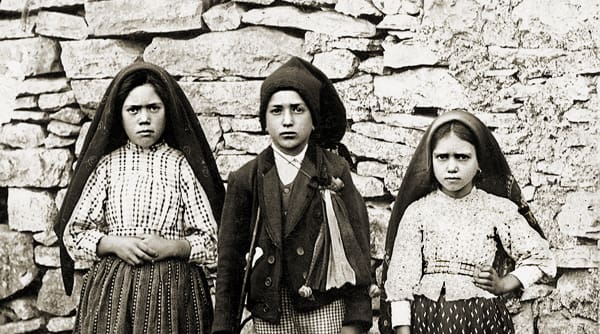
On May 13, 1917, Our Lady appeared to three poor, uneducated shepherd children. Jacinta, the youngest seer, was only seven years old. Her brother Francisco was eight, and Lucia, her cousin, was ten. The little peculiarities associated with the children’s accounts speak to the authenticity of their experience. For example, Francisco couldn’t hear Our Lady, he could only see her—unlike the two girls, who could both see and hear her. The message of Our Lady to the children at that time must also give us pause today: When Lucia asked Mary if Francisco would go to Heaven, Mary said that he would, but he would first have to pray many Rosaries. This eight-year-old boy only lived to be ten, and was a relatively good child—probably rambunctious and rebellious, but living in a much simpler time. How pure must Heaven be, that he had to pray many Rosaries before he could go there?
The effect of the vision on the children also speaks to the veracity of what happened there. Francisco was radically transformed into a model of virtue and piety, making it his goal to console the hidden Jesus in the tabernacle.
Our Lady appeared six times, and at every apparition, her message was essentially the same: “Pray the rosary every day in honor of Our Lady of the Rosary, to obtain peace for the world . . . because only she can help you.”
Remember, Mary was here instructing young children—there is no “age limit” when it comes to praying the Rosary. It is a powerful tool of intercession for every believer, of every age. Whether we like it or not and whether we obey or not, Mary is asking even little children to commit to at least a daily Rosary.
The consequences of sin were made clear in the third apparition; the Virgin Mary opened her hands, the earth opened up, and the children were given a vision of Hell. Not just a word or instruction about avoiding Hell, the Mother of God literally gave them a vision of Hell. Then she said, “You have seen hell, where the souls of poor sinners go. To save them, God wishes to establish in the world devotion to My Immaculate Heart. If what I say to you is done, many souls will be saved and there will be peace.”
Why is she doing this? What is she teaching us? Again, think of the climate we live in. Many of us have heard with our own ears that everybody goes to Heaven. Even in Catholic education the topic of Hell is tiptoed around. I experienced it myself, and I was
teaching eighth grade, far past the age of reason!
Now, I am not advocating for scare tactics; however, Hell is not a place you end up by accident. It is a choice that people make
knowingly and willingly.
Knowing that false teachings against Hell were entering the Church, Mary chose to give the most intense catechesis in the form of this horrific vision. In so doing, she bestowed on us an act of mercy: clear catechesis with sound teaching on morality. This is a message of hope and not one of fear. Mary is telling us that God wishes to save people through her Immaculate Heart.
Pray the Rosary because it brings peace. Pray the Rosary because it saves souls, including our own.
And then Our Lady requested an addition to the Rosary: “When you pray the Rosary, say after each mystery: O my Jesus, forgive us our sins, save us from the fire of hell. Lead all souls to heaven, especially those who are most in need of your mercy.” The Blessed Virgin’s preeminent concern is for the salvation of souls, and her message has a clear urgency. At every decade of the Rosary, she is asking that we make direct appeal to Jesus (through Mary) to save souls; it bears fruit even in those who are farthest away from God.
In addition to this, let me mention an important Latin axiom concerning prayer: Lex orandi, lex credendi, lex vivendi. The law of prayer, is the law of belief, is the law of living. In short, how we pray impacts what we believe and that impacts how we live. Praying to Jesus for the forgiveness of our sins to avoid the fires of Hell establishes in us a deeper belief of the eternal consequences of sin, which will change how we live. The adding of this prayer does obtain the grace we request, but it is also catechetical. In an age of moral relativism, where many want mercy without repentance, Our Lady keeps salvation before our eyes as the most important intention in every mystery. In the apparition, Our Lady says something similar: “Pray, pray very much, and make sacrifices for sinners; for many souls go to hell, because there are none to sacrifice themselves and to pray for them.”
She is inviting the children to pray and do penance. She is inviting us to pray and do penance. We have a role to play in the salvation of others. She is preaching this for several reasons, but primarily because it works. Prayer and penance work! Do you have a family member who is on the highway to Hell? You can help save them!
Our Lady came to Fatima not to scare children and punish us by asking everyone to pray the Rosary. She came to save us. She came to set the captives free. She came to give us the key to remove the shackles and bondage of sin and addiction. Don’t view the daily Rosary as a burden but as a source of freedom.
+
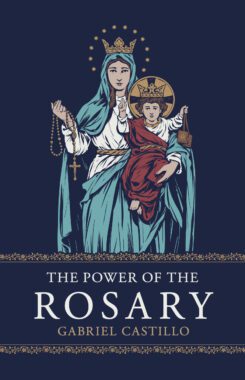
This article on the rosary is adapted from the book The Power of the Rosary by Gabriel Castillo which is available from Sophia Institute Press.
Art for this post on the rosary from The Power of the Rosary: cover used with permission; Photo used in accordance with Fair Use practices.