A Nativity Reflection from “The Prince of Peace” by Archbishop Alban Goodier
“And thou, Bethlehem Ephrata, art a little one among the thousands of Judah: out of thee shall he come forth unto me that is to be the ruler in Israel: and his going forth is from the beginning, from the days of eternity. . . . And he shall stand, and feed in the strength of the Lord, in the height of the name of the Lord his God: and they shall be converted, for now shall he be magnified even to the ends of the earth.” (Mic. 5:2, 5:4)
In meditating on the Child in the manger, we cannot do better than follow the meditations of His own saints. First is that of St. Paul; this is how his thoughts go: “For let this mind be in you, which was also in Christ Jesus: who being in the form of God, thought it not robbery to be equal with God: but emptied himself, taking the form of a servant, being made in the likeness of men, and in habit found as a man. He humbled himself, becoming obedient unto death, even to the death of the cross. For which cause God also hath exalted him, and hath given him a name which is above all names: that in the name of Jesus every knee should bow, of those that are in heaven, on earth, and under the earth: and that every tongue should confess that the Lord Jesus Christ is in the glory of God the Father” (Phil. 2:5–11). Thus St. Paul dwells upon the Nativity in its reference to Our Lord Himself, His humiliation in it, and His glory.
Next is St. John, writing long after St. Paul. He says, “The Word was made flesh, and dwelt among us (and we saw his glory, the glory as it were of the only begotten of the Father), full of grace and truth. . . . And of His fullness we all have received, and grace for grace. For the law was given by Moses; grace and truth came by Jesus Christ. No man hath seen God at any time: the only begotten Son who is in the bosom of the Father, he hath declared him” ( John 1:14, 1:16–18) And he comments on this passage in these words: “By this hath the charity of God appeared towards us, because God hath sent his only begotten Son into the world, that we may live by him. In this is charity: not as though we had loved God, but because he hath first loved us, and sent his Son to be a propitiation for our sins. My dearest, if God hath so loved us; we also ought to love one another” (1 John 4:9–11). Thus St. John dwells upon the Nativity in its reference to us.
Yet a further contemplation is that of St. Ignatius of Loyola. He bids us “to see and consider what they are doing—that is to say, the journey and the labor that they undergo in order that Our Lord may be born in extreme poverty; and in order that after such toils—after hunger, thirst, heat, cold, insults, and affronts—He may die on the Cross, and all this for me; and then by reflecting to derive some spiritual profit.” Thus does the saint apply to this meditation his principle that “love ought to be found in deeds rather than in words” (see 1 John 3:18); and by dwelling on the deeds of love of Christ Our Lord, begun here in the manger of Bethlehem, he would stir us to like deeds of love in our degree; how, as he says elsewhere, “I on my side, with great reason and justice, ought to offer and give to His Divine Majesty all things that are mine, and myself with them.”
+
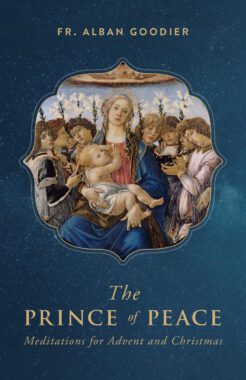
This article on the Nativity is adapted from the book The Prince of Peace by Archbishop Alban Goodier which is available from Sophia Institute Press.
Art for this post on a reflection from The Prince of Peace: cover used with permission; Photo used in accordance with Fair Use practices.