A Reflection from “A Rosary for Every Heart” by Jennessa Terraccino
Do you find that you connect to God through His creation? Certainly, St. Francis of Assisi was a lover of wildlife. Just as a child may resemble his parents, God’s creation is stamped with signs of Him. Like the Bible, the tangible world truly reveals God. When simple matter such as wheat, wine, fauna, and flora are considered, these slices of nature can bloom into fresh spiritual insights. Using your five senses in prayer makes for fruitful meditations for the Franciscan heart. Zoom in on the created world even while you pray the mysteries of the Rosary.
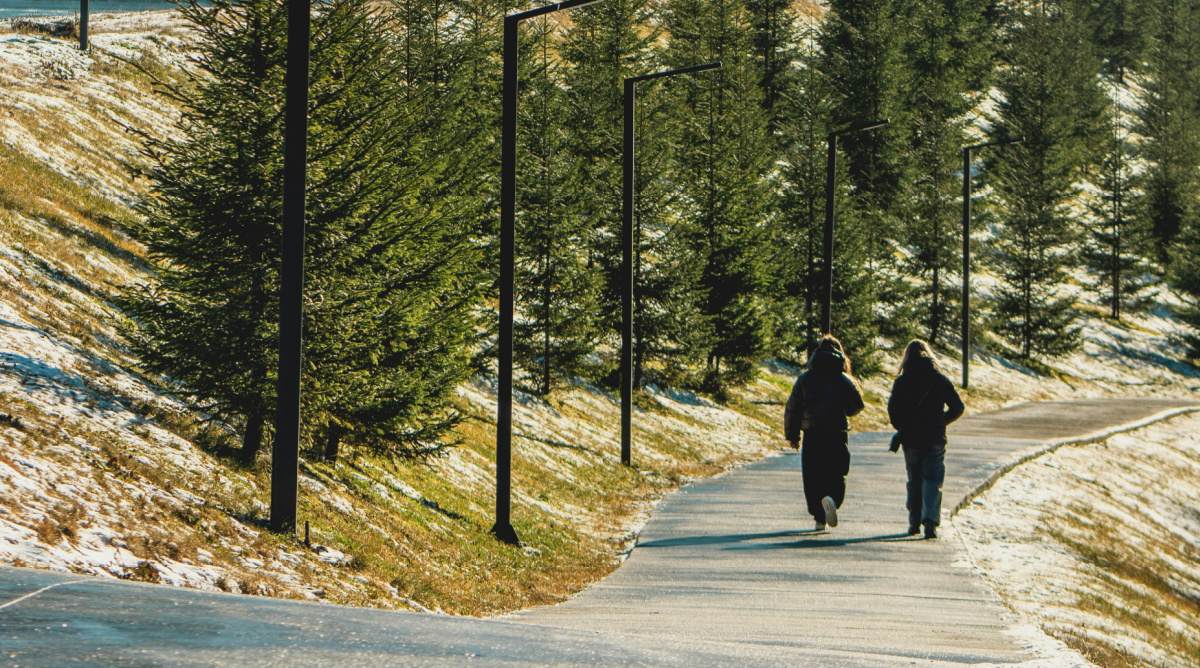
Through the Franciscan lens, you can also imagine yourself in the places where Jesus lived and taught. Many of the churches and pilgrimage sites in Israel are, in fact, maintained by the Franciscan Order. Picture what the stones and mortar of the Holy Land are like. Where did Jesus walk? What remains there today? These historical physical signs and relics of the past speak wonders. Finally, with your Rosary, encounter God in motion: walk while you pray, open yourself to the Holy Spirit, and allow the natural to lead you to the supernatural.
St. Francis of Assisi, pray for us!
The First Joyful Mystery: The Annunciation
Fruit of the Mystery: Humility
Scripture: Luke 1:26–38
In the sixth month the angel Gabriel was sent from God to a city of Galilee named Nazareth, to a virgin betrothed to a man whose name was Joseph, of the house of David; and the virgin’s name was Mary. And he came to her and said, “Hail, full of grace, the Lord is with you!” But she was greatly troubled at the saying, and considered in her mind what sort of greeting this might be. And the angel said to her, “Do not be afraid, Mary, for you have found favor with God. And behold, you will conceive in your womb and bear a son, and you shall call his name Jesus. He will be great, and will be called the Son of the Most High; and the Lord God will give to him the throne of his father David, and he will reign over the house of Jacob for ever; and of his kingdom there will be no end.”
And Mary said to the angel, “How can this be, since I have no husband?” And the angel said to her, “The Holy Spirit will come upon you, and the power of the Most High will overshadow you; therefore the child to be born will be called holy, the Son of God. And behold, your kinswoman Elizabeth in her old age has also conceived a son; and this is the sixth month with her who was called barren. For with God nothing will be impossible.” And Mary said, “Behold, I am the handmaid of the Lord; let it be to me according to your word.” And the angel departed from her.
Reflection: The Story of the Stones
The humble land of Nazareth became holy the day an obscure woman said yes to an extraordinary invitation. At the time of the Annunciation, Nazareth was home to a mere hundred families, working mostly as farmers and shepherds. Like St. Joseph, a handful of people were carpenters. Can you see the sprawling farmland, dusty paths, and flocks of sheep? Take a minute to picture the terrain.
Over the centuries, the sacred spot of the Annunciation has had a colorful construction. At least four churches were built and destroyed (including a church built by the Franciscans in the eighteenth century) before the current one was built in 1969. Today, the Basilica of the Annunciation stands as the largest shrine in the Middle East. The remains of prior sanctuaries can still be found in the crypt of the church.
When Mary met the angel Gabriel, she was likely at home. In the modern lower church is the Grotto of the Annunciation — the exact spot of the encounter. Inscribed in the altar is the Latin phrase “Verbum caro hic factum est”: “Here the Word became flesh.” Imagine running your fingers in the grooves of the letters chipped in that stone.
Mary’s structural home no longer rests in Nazareth, however, but in Loreto, Italy. Attached to the Grotto in Nazareth are foundational remains, which have been studied by archaeologists and correspond to the proportions of the House of Loreto. Angels moved the home on a December evening in 1294. If Mary can conceive miraculously, there is no reason why a structure can’t be transferred supernaturally. Therefore, the mystery of the Annunciation can also be contemplated in a special way in Italy. The Holy Family’s home is housed in the Basilica of Loreto. Jesus lived and breathed within those walls stacked with stones, and He grew up to become the Cornerstone (Eph. 2:19–20). Can you hear the laughter and feel the love that filled that home?
In reality, there is no need to travel to Israel or Italy: Every tabernacle offers us a physical opportunity to celebrate and contemplate the Incarnation, when “the word became flesh and dwelt among us” (John 1:14). And we can be home with Mary anywhere. Every year, the Feast of the Annunciation is celebrated on March 25 — nine months before Christmas, the time Jesus spent in His first earthly home, Mary’s womb.
Take away to pray: As you meditate on this mystery, think about rocks: the stones of Christ’s first home, the foundation of the Basilica of the Annunciation, the universal Church built upon St. Peter the Rock, and Jesus as the Rock of Salvation. Be inspired by Mary’s concrete yes and become “like living stones . . . built into a spiritual house” (1 Pet. 2:5).
+
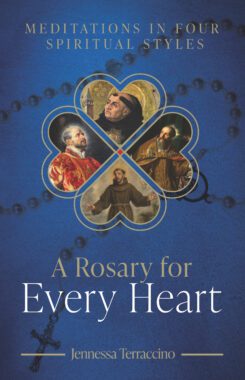
This article on the Annunciation is adapted from the book A Rosary for Every Heart by Jennessa Terraccino which is available from Sophia Institute Press.
Art for this post on a reflection from A Rosary for Every Heart: cover used with permission; Photo used in accordance with Fair Use practices.