A Reflection from “The Truth About Purgatory” by Martin Jugie
The Catholic dogma of Purgatory supposes the immortality of the human soul, and the existence, for that soul, of another life after death has separated it from its vesture of clay. We are not concerned here with demonstrating the immortality of the soul. That is a truth of the rational order, confirmed by Christian revelation—a truth that is fundamental, that is basic to the whole moral order, and that, despite all the efforts of materialism, shines with undimmed splendor.
Death is, therefore, for the human soul, the beginning of a new life, about which, though the Catholic religion furnishes us with certain precise ideas, our curiosity is far from being satisfied. Yet what we do know is no mere guesswork. It comes to us stamped with the infallible teaching authority of the Church.
According to this teaching, the soul immediately after death goes to Heaven, or to Hell, or to Purgatory, according to the nature of its relations with God at the precise moment of death.
If it is in a state of perfect friendship with God, being entirely free from both mortal and venial sin and having done sufficient penance for sins committed after Baptism, it is immediately admitted to the Beatific Vision—the vision of the three Divine Persons in One Only God, which renders the soul ecstatically happy. This state of beatitude, given to man in proportion to the love of God he attained to while on earth, is known as Heaven. Heaven, for the soul separated from the body, is above all a state, the state of perfect felicity. It is also, according to our manner of conceiving it, a place, but a place in the wide sense, a place only by analogy, since the soul, being a spirit, cannot be properly speaking localized. Heaven is where Jesus Christ, true God and true Man, with His glorified body, lives with His Virgin Mother and the glorified of the first Paschal day. One can say that Heaven, considered as a state, is everywhere that God is. But God is everywhere.
If the soul, at death, is constituted in a state of enmity with God, through having one or more mortal sins unrepented of to the very last breath, it is driven away from Him and plunged into a state of damnation. This state will be eternal, for after death, the soul does not change. It remains immutably fixed in the dispositions which it had at the moment of death. After death, there is no repentance, there is no conversion, according to a dogma of the Catholic Faith. The damned soul no longer desires God. It detests Him and will detest Him eternally. God can no longer pardon that soul, for it no longer wishes to ask for pardon, and there is thus fixed between them a great chasm. This state of damnation is called Hell. Notice that it is primarily a state. It is also a place, but in the analogical sense pointed out above in reference to Heaven. Just as the blessed soul, wherever it is, carries its Heaven with it, because it is united to God by vision and love; so the damned soul cannot escape from its Hell, because it is deprived of the Beatific Vision of God, whom it detests, eternally resenting the weight of His justice.
Finally, if at death the soul is in a state of grace and amity with God, but is as yet unworthy to be admitted to the Beatific Vision—either because of venial sin unrepented, or the lack of sufficient penance for both mortal and venial sins, or both—it must pass some time, long or short according to the amount of its debt, in an intermediate state between the state of beatitude and that of damnation. This state is designated, in the Latin Church since the eleventh century, by the word Purgatory, that is, a state or place of purification, of expiation. This state is characterized: first, by eternally assured amity with God, arising immediately from the changelessness of the soul, fixed in the certain hope of sooner or later coming to the Beatific Vision; second, by the temporary privation of that vision; third, by mysterious sufferings arising from that privation and proportionate to the number and gravity of sins not sufficiently expiated here below. Like Heaven and Hell, Purgatory too is a state; but they are eternal states and it will pass. Purgatory is also a place, in the sense in which separated souls can be said to be in a place. It is a station of penance, where the soul must endure the rigors of chastisements: a kind of Marshalsea, where the soul is detained for spiritual debts it has failed to meet on earth: an exile, full of sorrow, far from the fatherland, far from the father’s house—an exile which of its nature will end happily, and which the Church Militant and the Church Triumphant, each in its own fashion, can alleviate and shorten. But the imprisoned and exiled souls can do nothing for themselves to sweeten or take away the pains to which they were condemned at the particular judgment. Such is the general idea of the state called Purgatory. It remains to sift and analyze it.
+
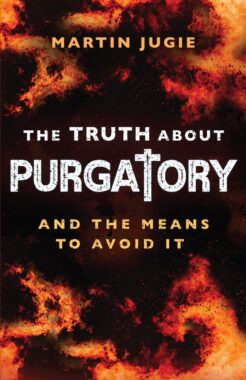
This article on purgatory is adapted from the book The Truth About Purgatory by Martin Jugie which is available from Sophia Institute Press.
Art for this post on a reflection from The Truth About Purgatory: cover used with permission; Photo used in accordance with Fair Use practices.