A Reflection from “Persecuted from Within” by Joshua Charles and Alec Torres
St . Teresa
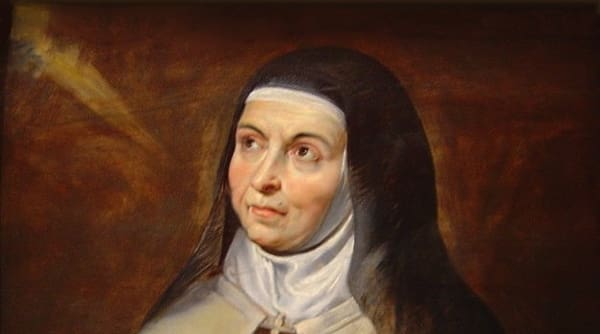
The role of reformer—or, in a sense, of re-foundress—would have seemed an unlikely one for Teresa of Avila to play, at least when she was young. She writes in her Vida that her early desire to become a nun was soon forgotten under the influence of the world. During her teenage years, she became preoccupied with her attractive appearance and with being popular. At one point she even considered giving up religious life and marrying one of her cousins. When she lodged at a house of the Augustinian order as a young woman, she decided not to join it because it was too strict.
Teresa entered the Encarnacion Carmelite convent in her hometown of Avila at the age of twenty in 1535, in large part because a friend of hers had already entered the same convent. At the time there were forty nuns in Encarnacion. Ten years later, there were 165. While this might appear to be a miraculous boom in vocations, the reality is that during this time many Spanish women entered convents for worldly reasons, such as a desire to avoid marriage or a lack of marriage prospects. (St. Teresa herself repeatedly told her nuns to be grateful that they were nuns and not married.) At this time, many Spanish men, including St. Teresa’s brothers, had gone to seek a better life in the New World or to fight in Spain’s many wars. As a result, there were large numbers of abandonadas, women who had chosen to live a common life with other women. The “abandoned” were not necessarily bad, or insincere, nuns. But their enthusiasm for following the order’s rule or living out its asceticism was sometimes muted. (St. Teresa would later forbid convents to have more than thirteen women, since smaller communities were easier to hold accountable.)
Sixteenth-century Spain was an honor society and extremely class-conscious. It sounds surprising to us today, but rooms at Encarnacion convent were given to the nuns largely in accord with their social status, and they could also be bought and sold. Teresa’s cell had two levels and was large enough to host her sister Juana for several years. Indeed, as Teresa was the daughter of an hidalgo (minor nobility), she was also referred to as Doña Teresa, or Lady Teresa, rather than Sr. Teresa.
The wealthier sisters wore finer clothing than the poorer ones, and the wealthiest families could give their daughters as much money as they wanted. The result was extreme inequality and class-consciousness, even in a house of religion. Despite her own social position, this infuriated Teresa more than anything else she saw in the convent, and she stood against the spirit of her age and her own country by seeking to end it.
Another regular trouble was Encarnacion’s finances. Some sisters even had to get side jobs sewing or tutoring. The sisters had to raise money to keep the house open, and there were visitors of both sexes chatting in the parlors practically all day long. St. Teresa writes that in this environment she grew lax and backslid into her previous struggles with vanity and the desire to be popular.
I myself was vain and liked to be well thought of in the things esteemed by the world. . . . It was a very bad thing for me not to be in a convent that was enclosed. The freedom . . . would certainly have led me, who am wicked, down to hell, had not the Lord, through very special favors . . . delivered me from this peril. It seems to me, then, that it is a very great danger for women in a convent to have such freedom: for those who want to be wicked it is not so much a remedy for their weaknesses as a step on the way to hell. . . . Let [parents] be prepared to allow [their daughters] to marry far beneath their stations rather than put them into convents of this kind. . . . It is better to keep them at home; for there, if they want to be wicked, they cannot long hide their wickedness, whereas in convents it can be hidden for a very long time.
The saint records that eventually an older nun warned her about her familiarity with the outside world on several occasions, but she did not listen. St. Teresa became so preoccupied with receiving visitors and leaving the house that she—history’s greatest advocate of mental prayer—left off the practice of mental prayer for a full year.
When the saint began to spend time with one worldly woman in particular, Our Lord appeared to her in a vision as a stern and angry judge. She broke off the friendship, and the terrifying vision haunted her for the rest of her life.
Worldliness and corruption were problems not only in the convent but throughout the Church in Spain at the time. Although it is tempting to imagine a past when all the world was devout, in reality many entered religious life for worldly reasons, and many priests in Spain openly had girlfriends and concubines. The Spanish Inquisition prosecuted eight priests for seducing women through “spiritual counsel,” and a local synod reiterated the condemnation of fornication by priests. St. Teresa records her shock upon discovering that her own confessor was entangled with a local woman, and she records her successful prayers for his conversion and repentance.
St. Teresa’s “Second Conversion”
In 1554, at the age of thirty-nine and after nearly two decades as a nun, the saint experienced her “second conversion” after she was given a copy of St. Augustine’s Confessions, which had only been translated into Castilian earlier that year. “When I read the Confessions,” she later wrote, “I seemed to see myself in them. . . . When I got as far as his conversion and read how he heard that voice in the garden, it seemed exactly as if the Lord were speaking in that way to me. . . . I remained for a long time dissolved in tears.”
This moment proved to be the beginning of the reforms of the Carmelite Order. “I began to long to spend more time with God, and to drive away occasions of sin.”
Soon after this, in 1556, St. Teresa began to receive visions and locutions from Our Lord, Our Lady, and the saints.
+
This article on St. Teresa is adapted from the book Persecuted from Within by Joshua Charles and Alec Torres which is available from Sophia Institute Press.
Art for this post on a reflection from Persecuted from Within: cover used with permission; Photo used in accordance with Fair Use practices.