A Reflection from “Remain In Me and I In You” by Fr. Wayne Sattler
Just as Jesus met Peter where he needed to be loved, where he needed to be saved, He does the same thing for each of us. We can see this clearly in the lives of the saints.
Jesus knew where Agnes Gonxha Bojaxhiu needed to be led, to be who God created her to be. Mother Teresa wasn’t looking for opportunities to do something hard with her life. She was a soul who loved the Lord and strongly desired to be where He is. Our Lord led her to be with Him, in what she would come to recognize as “Jesus, in the distressing disguise of the poorest of the poor.” It was there that she would be who God created her to be, where her own capacity to be filled by God would increase.
An American tourist in India stood by in awe as he watched Mother Teresa lovingly clean the infected wounds of a horribly disfigured leper. “Sister,” he commented, “I wouldn’t do that for a million dollars!” Her response: “Neither would I, brother. Neither would I do what I do for a million dollars. But for the love of God, I do it gladly.”
We are grateful Mother Teresa did not miss out on being where Jesus is, even in the distressing disguise of the poorest of the poor—especially in the distressing disguise of the poorest of the poor. Our Lord knew where Agnes Gonxha Bojaxhiu needed to be led to be- come St. Teresa of Calcutta. In her we see the fulfillment of St. Catherine of Siena’s observation, “Be who God meant you to be, and you will set the world on fire.”
Our Lord knew where Karol Wojtyla needed to be led, to be who God created him to be, where his own capacity to be filled by God would increase. In the homily of his Mass of Thanksgiving on the twenty-fifth anniversary of his pontificate, he reflected how “at the Conclave, through the College of Cardinals, Christ said to me, as He once said to Peter by the Lake of Gennesaret, ‘Tend my sheep.’ I heard echo in my soul the question He addressed to Peter at that moment, ‘Do you love me? Do you love me more than these?’ ” After detailing his acceptance, he went on to confide how “every day that same dialogue between Jesus and Peter takes place in my heart. In spirit, I focus on the benevolent gaze of the risen Christ. Although He knows of my human frailty, He encourages me to answer confidently, like Peter, ‘Lord, you know everything; you know that I love you.’ And then He invites me to take on the responsibility that He Himself has entrusted to me.” Our Lord knew where Karol Wojtyla needed to be led to become St. John Paul II.
It is by being alone with God in our heart that we will hear Our Lord ask, “Do you love me?” If we listen carefully, we will hear Him ask us again and again and again. We must pray for the desire to truly know Him, love Him, and be where He is. One thing we cannot give to another human being is desire. We might tell another person why they might want to be where the Lord is. We can strive to model for others what it might look like to be where the Lord is. But we cannot give to another person the desire to be where the Lord is. It is they who must be pierced by the Lord asking them, “Do you love me?” It is they who must desire to be where He is.
A Carthusian observes,
One of the most beautiful definitions of a monk is that he is a man of desire. … The day when he feels full to overflowing, he ceases to be a monk—and is living an illusion. God never surfeits us with the gift of himself but creates in us an ever larger capacity for love and, having done this, he replenishes us with a desire, a thirst, more ardent still. And it will always be this way with God for eternity without end, because God is without end. If we arrive at the end, it is not God.
+
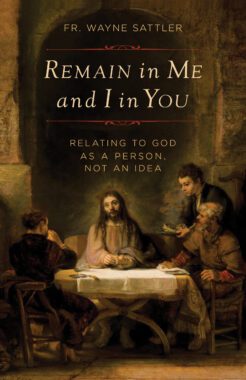
This article on Jesus and holiness is adapted from the book Remain In Me and I In You by Fr. Wayne Sattler which is available from Sophia Institute Press.
Art for this post on a reflection from Remain In Me and I In You: cover used with permission; Photo used in accordance with Fair Use practices.