

A Reflection from “The Power of the Rosary” by Gabriel Castillo
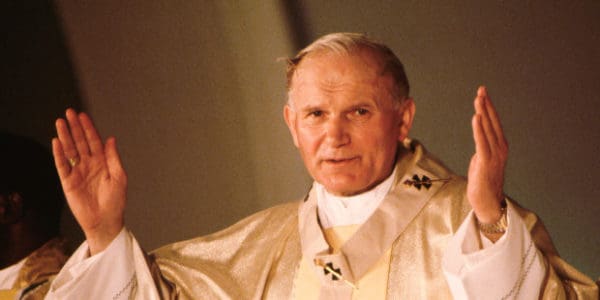
On multiple occasions I have accidentally caught myself referring to St. John Paul II as “my dear friend.” It just comes out and catches me off guard, and I am quick to clarify that I never actually met him, yet I do genuinely consider him a friend because St. John Paul II was extremely influential in my early formation. I feel that I have a deep understanding of his heart, due in no small way to the fact that he poured himself out so openly for young people.
Like St. Dominic, Karol Wojtyla’s mother had a prophetic vision of her son. According to George Weigel, she proclaimed: “My Lolek will be a great man someday.” (Lolek was the diminutive form of Karol.) Their family, like most Polish families, had a great love for the Virgin Mary. Karol’s mother died just before his ninth birthday, and upon learning of his mother’s death, this heartbroken boy ran to the parish church and dropped to his knees before an image of Mary. The young Karol said to the Mother of Christ, “You must be my mother now.”
Let that sink in. Think of this from the perspective of Mary. A boy who just lost his mother makes a heartfelt consecration. If you know Mary, you know she was deeply moved by this and that she takes this kind of entrustment very seriously. Karol Wojtyla accepted her, and she accepted him.
As a boy, Karol might not have heard of Our Lady of Fatima, but he saw the fruits of what she was warning about. He saw first-hand Russia spreading her errors. Karol lived in Poland during the height of the Nazi invasion and later under the shadow of Russian occupation. He had an extremely difficult life, and indeed, all of Poland was suffering.
Karol said that one of the most influential witnesses in his life was that of his father, who not only took Karol’s catechesis and formation seriously but also led by example. On more than one occasion, young Karol would wake up in the middle of the night and catch his father on his knees praying the Rosary. Sometimes he would wake up very early and find the same thing. This sort of witness leaves on young souls a profound and lasting impact that can never be erased.
I didn’t have a father growing up, and when I first heard this and the impact that it had on Karol, I thought to myself, “I want to be a man like that.” The world would be different if all fathers lived like this. The greatest inheritance Karol’s father gave him was a love for Mary and the Rosary. This love for the Rosary was deeply ingrained upon his heart, was part of his culture, and was the strength of his family. Karol said that his home was his first seminary.
As a young man Karol was deeply impacted by a mystic and playwright who acted as a spiritual director. Jan Tyranowski would introduce Karol to the writings and spirituality of St. John of the Cross and St. Teresa of Ávila. Karol became a young man of deep contemplative prayer, so much so that he attempted to join the Carmelites, but his bishop saw another path. This is critically important for understanding the young man’s love and appreciation for the Rosary, which can only be properly utilized if you understand it in its deepest contemplative dimension. Karol understood this: The Rosary isn’t just repeating the Hail Mary; it is first and foremost an encounter with Christ in the mysteries. The Hail Marys act as sort of a background song that stirs up the spirit, keeps distractions at bay, and acts as a timer for the encounter.
As pope, St. John Paul II took as his papal motto Totus Tuus. Many are familiar with the motto, but what most people haven’t reflected on is that it wasn’t just a motto for himself. By taking on this motto, he was proclaiming the Marian lifestyle as one suitable for the universal Church and as the spirituality for every person.
He was giving testimony of the power of Marian consecration in his own life, but that does what a good testimony is meant to do—spark interest in others, which is why we have seen a boom in total consecration. St. John Paul II put a spotlight on St. Louis de Montfort, Mariology, and total consecration unlike any other individual in human history.
Also, it isn’t just a motto; it isn’t just a testimony. It is a prayer. He totally gave his pontificate to Mary, and do you know what Mary does when you give her everything? She accepts it, and she transforms it, and she gives you everything. Mary is not outdone in generosity. What you give to her, she transforms and offers back to you manifold. What do you want of me, Mary? That is what St. John Paul II was saying. And as we will see, Mary wanted a radical change: not a removal of the Rosary but an increase.
St. John Paul II was Polish. The history of Poland is the history of a nation that consecrated herself fully to Mary—even at the highest levels of government—and of a people who were repeatedly invaded and attacked, yet found refuge under the mantle of Mary. For the Polish people, yes, Mary is a loving mother; yes, Mary is a good queen. But she is also a fierce warrior. There are so many stories of Mary defending the Polish people in battle. Ponder for a moment the image of the Black Madonna of Czestochowa. She wears a scar on her face. The history of Our Lady of Czestochowa is one of battle. St. John Paul II helped to overthrow the communist regimes—the work of Satan as warned by Our Lady of Fatima—not by physical arms, but by spiritual ones.
On May 13, 1981, the feast of Our Lady of Fatima, St. John Paul II was shot in St. Peter’s Square. The details of his survival are nothing short of miraculous. When questioned about the event, St. John Paul II said, “One finger was pulling the trigger, but another finger was guiding the bullets.” Only an atheist could deny the connection with the message of Fatima. St. John Paul II himself went to Fatima many times to pay homage to Our Lady of the Rosary, and he had the bullet that pierced his body placed in her crown. His pontificate and the message of Our Lady of the Rosary at Fatima are one.
+
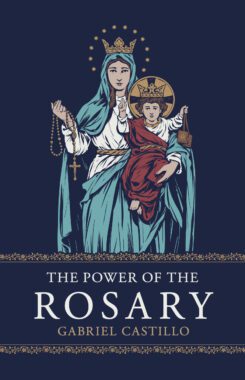
This article on the rosary is adapted from the book The Power of the Rosary by Gabriel Castillo which is available from Sophia Institute Press.
Art for this post on the rosary from The Power of the Rosary: cover used with permission; Photo used in accordance with Fair Use practices.