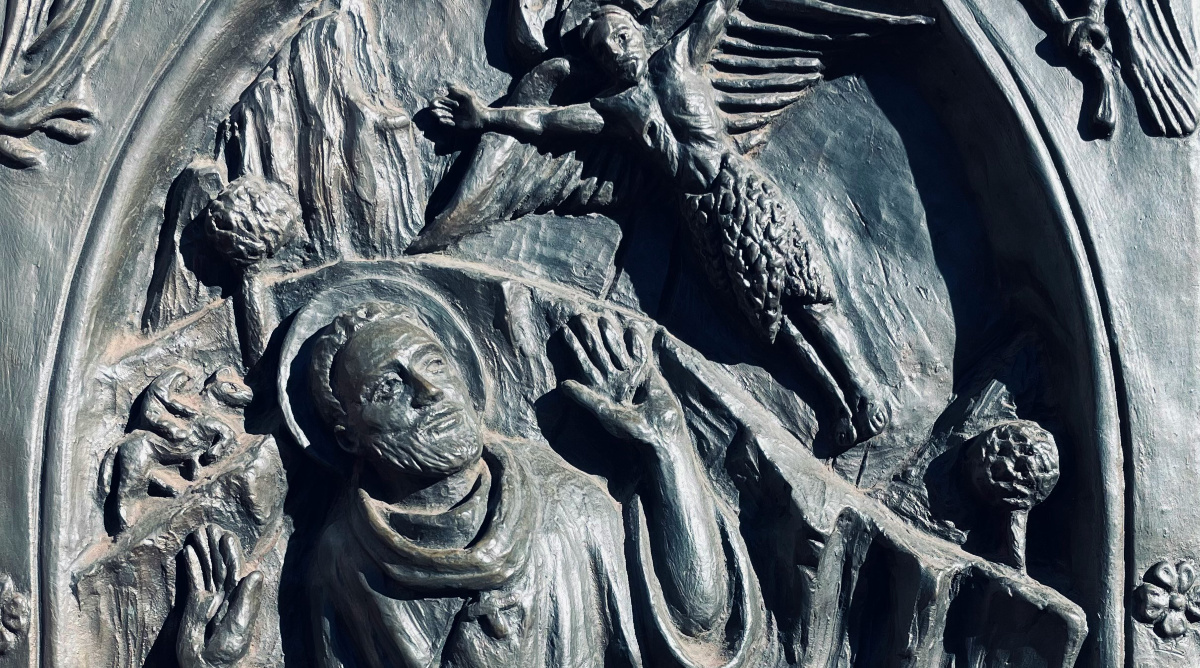
A Reflection from “Wisdom from the Cross” by Casey Chalk
Following the Great Forgiver
The earliest Christians saw Jesus’ willingness to forgive His enemies as a model for their own lives. Certainly St. Stephen, the Church’s first martyr, viewed it as an exemplar to follow. When the Jewish leaders decided to stone Stephen to death, he “cried with a loud voice, ‘Lord do not hold this sin against them’” (Acts 7:60). The charity of Christ had come to possess his heart, and that love refused to be crushed by the stones of the angry Jewish crowd.
It was much the same for James the Apostle, the first bishop of Jerusalem. Fourth-century historian Eusebius tells us that, as the scribes and Pharisees were pelting St. James with stones, he cried out in words practically identical to Christ’s: “Lord, pardon them, for they know not what they do.” St. Paul, writing to the Corinthians, expresses the same mentality: “When reviled, we bless; when persecuted, we endure; when slandered, we try to conciliate” (1 Cor. 4:12–13).
Following the example of the apostles, saints across the centuries have imitated the ready mercy and forgiveness of their Lord. St. Engelbert, the thirteenth-century archbishop of Cologne, was attacked by enemies who had lain in wait for him. As he died, he prayed, “Father, forgive them.” St. Paul Miki, the sixteenth-century Japanese Jesuit, reportedly declared from his own cross, “The Christian law commands that we forgive our enemies and those who have wronged us.” So too St. Charles Lwanga, a nineteenth-century Ugandan Christian, forgave the king who ordered his execution. Bellarmine summarizes: “If Christ forgave and prayed for His executioners, what reason can be alleged why a Christian should not act similarly to his enemies?”
Christ’s forgiveness, and our imitation of His mercy, also serves an evangelical purpose. As the book of Acts tells us, Christ’s absolution of His enemies opened the path for others’ repentance. Many men and women were persuaded both by Jesus’ example and the apostles’ preaching to confess Him whom they had denied and adore Him whom they had despised. Seeing a dying man respond to those who had wronged Him, not in malice but in charity, how could their hearts not soften? God seems intent on sowing His seeds of salvation even in the most barren soil. Following Jesus’ example, Christians over the centuries have pardoned their enemies and even prayed for those enemies who have caused them all manner of harm. We are called to do the same, obeying Christ’s exhortation at the Sermon on the Mount: “Love your enemies and pray for those who persecute you” (Matt. 5:44).
And the more we forgive, the more spiritual rewards we reap, as we grow in grace and virtue. Bellarmine explains:
Oh, if Christians would learn how easily they can, if they wish, acquire inexhaustible treasures, and merit signal degrees of honor and glory by gaining the mastery over the various agitations of their souls, and magnanimously despising small and trivial insults, they would certainly not be so hardhearted and obstinately set against pardon and forgiveness.
Overcoming our inclination to harbor grievance frees us to more easily and fully follow Christ and to win for ourselves the eternal crown of righteousness (see James 1:2; 2 Tim. 4:8; 1 Pet. 1:6-7). “Forgive another, and you are ‘imitating God,’ you are made like God,” urges St. John Chrysostom.
Given the importance that Christ and His followers placed on forgiveness, it should not surprise us to learn the manifold health benefits of forgiveness. A randomized study of 4,598 people from around the world, published in 2023, found that forgiveness resulted in a “meaningful reduction in depression and anxiety symptoms.” According to Johns Hopkins Medicine, studies associate the act of forgiveness with “lowering the risk of heart attack; improving cholesterol levels and sleep; and reducing pain, blood pressure, and levels of anxiety, depression and stress.” Moreover, research indicates an increase in the connection between forgiveness and improved health as we age—which makes sense, given that our souls and bodies are intimately united.
On the other hand, there are grave spiritual consequences if we fail to forgive. Jesus warns us, “If you forgive men their trespasses, your heavenly Father also will forgive you; but if you do not forgive men their trespasses, neither will your Father forgive your trespasses” (Matt. 6:14–15). Holding grudges and allowing old grievances to fester, Our Lord tells us, is dangerous to our soul and will affect our eternal destiny. Allowing these things to linger damages our earthly relationships and risks forfeiting our very salvation. As St. Augustine warns us: “Brethren, if we have sins, let us forgive them that ask us. Let us not retain enmities in our heart against another. For the retaining of enmities more than anything corrupts this heart of ours.”
There are also temporal consequences of refusing to forgive. Holding onto grudges often leads to discord and exacerbation of conflict. Though we may think our anger is directed only at those individuals who have angered or insulted us, our resentment spreads like cancer in our soul, poisoning us and our relationships with others, often compounded by the sin of gossip. Sometimes entire communities are affected by unresolved, unforgiven disputes. Consider the Capulets and Montagues in Shakespeare’s Romeo and Juliet, whose bitter battles rocked the Italian city of Verona. Refusing to forgive, argues Bellarmine, plays into the strategy of the devil, who urges us to maintain our resentments, sowing discord and enmity in our communities.
+

This article on forgiving is adapted from the book Wisdom from the Cross by Casey Chalk which is available from Sophia Institute Press.
Art for this post on a reflection from Wisdom from the Cross: cover used with permission; Photo used in accordance with Fair Use practices.