There have been many apparitions of Our Lady throughout the centuries. While the location of the apparition may differ, the sense of Our Lady’s maternal care for Her children is strong. In the year 2031, it will be the 500th anniversary of Our Lady’s apparition to St. Juan Diego on Tepeyac Hill outside of modern-day Mexico City. As this anniversary approaches, Catholics would do well to learn more about the events leading up to and surrounding the great apparition of Our Lady of Guadalupe.
The years preceding her appearance in 1531 had been a dark time for many people in the geographical region we refer to as Mexico and Central America. It can be argued that the Spaniards’ motives were mixed in their exploration of the New World. Some of the Spanish were driven by a desire for conquest and the discovery of gold. Hernán Cortés, the Spaniard leading the expedition, had his faults. However, he was a man with a strong prayer life who attended Mass whenever possible. He encouraged the Spanish missionaries who accompanied the expedition to spread the Catholic faith to the native peoples.
One fact that is often overlooked during the Spanish exploration of the New World was the prevalence of human sacrifice as part of the indigenous religious practices. Aztec priests were frighteningly efficient in their capacity to execute and sacrifice their human victims. While the exact number of victims is known to only God, it is safe to say that tens of thousands of adults were sacrificed yearly for decades. In the year 1487, at the dedication of a new temple in their capital city of Tenochtitlan, Aztec priests sacrificed 80,000 people over the course of the four-day dedication ceremony. 1 One of the greatest benefits to the native peoples was the fact that the Spanish ended the brutal practices of human sacrifice that had been so prevalent in those lands. Still, over the course of the next twenty years, few natives converted to Catholicism. Many wanted nothing to do with the religion of their European conquerors.
That all changed when Our Lady appeared to St. Juan Diego in early December of 1531. Over the course of several days, the Blessed Mother appeared four times to a man of simple faith and instructed him to go to the local bishop to request that a Church be built on top of Tepeyac Hill. Our Lady’s first message gave St. Juan Diego his instructions to go to the Bishop of Mexico City to tell him that the Mother of God wanted him to build a Church on Tepeyac Hill. There would be three more apparitions in the following days. The Bishop saw St. Juan Diego’s goodwill, but he proceeded cautiously. The Bishop declared that he needed a sign from this mysterious woman who claimed to be the Mother of God. The desired sign was given when St. Juan Diego collected beautiful Castilian roses in his tilma from a dry, rocky hill where nothing could or should have been growing in the frozen days of December 1531. In addition to the roses, a miraculous image of a beautiful woman was imprinted on the cactus fiber cloth tilma that St. Juan Diego wore for warmth.
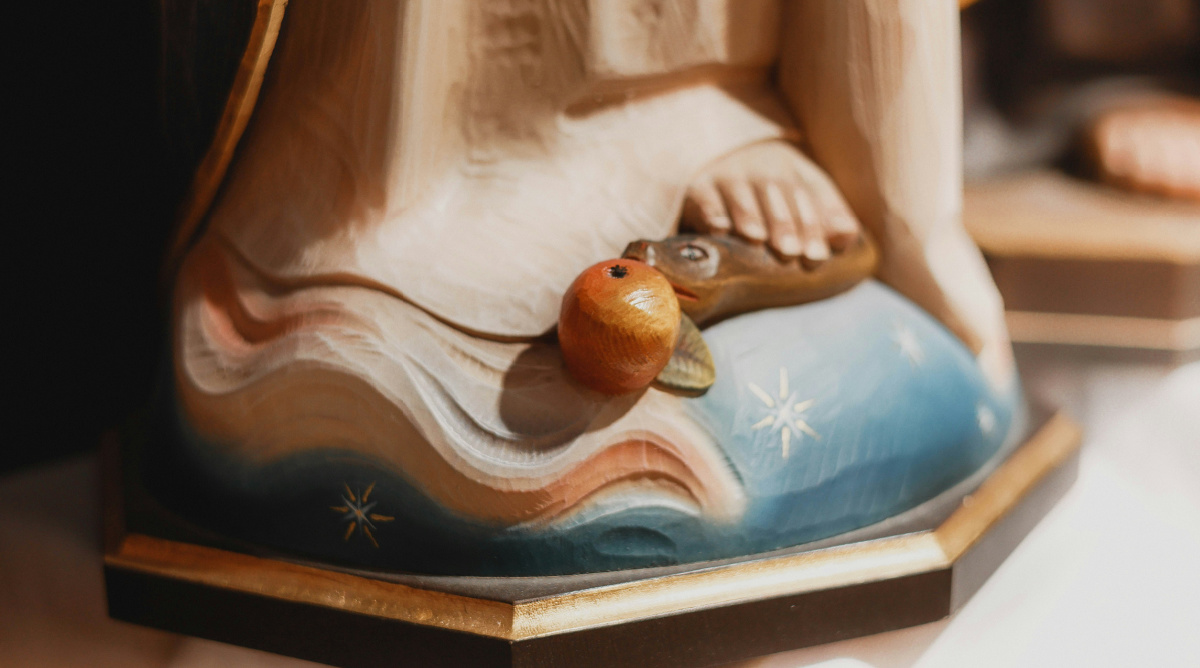
Because the image of Our Lady on the tilma was filled with symbols significant to the Aztec peoples, there were immediate conversions to the Catholic faith. From the color of her skin, they recognized her as mestiza, both Aztec and Spanish, indicating the two cultures coming together at that time in history. The fact that She was standing on the crescent moon, the symbol of the Aztec moon god Quetzalcoatl (whose symbol was a serpent), indicated that she was more powerful than him.? The ribbon around her waist indicated that she was pregnant. Because she was a woman powerful enough to defeat Quetzalcoatl, it was assumed she must be preparing to give birth to the Son of God. Detailed studies of the Lady’s eyes by physicians and ophthalmologists have revealed mysteries of their own.
The tilma itself is a miracle. It is made of cactus fiber, and it should have deteriorated after twenty years. Artists and scientists have studied the image, and they cannot determine how exactly the image was put onto the tilma. There are no brush strokes to indicate the work of an artist. These are only a few of the symbols that theologians and scientists have identified in looking at the tilma.
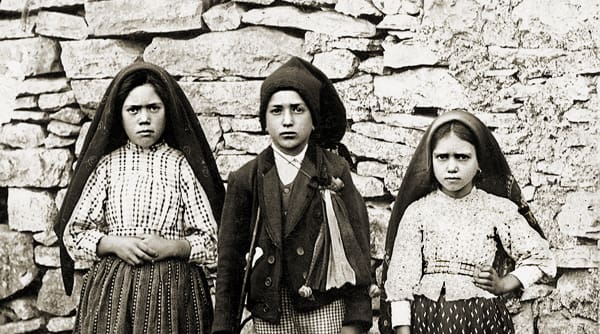
As beautiful as the story is, Catholics are not obliged to believe all that has been written about Our Lady of Guadalupe (or any Marian apparitions, such as Fatima, Lourdes, Akita or Champion).?? Catholics understand that Marian apparitions (and the associated messages) fall into a category known as “private revelation”. This is distinct from the “public revelation” that Jesus proclaimed in His ministry on earth and which His apostles taught in their ministry. Private revelations are not a part of the deposit of faith, and information they reveal is not absolutely necessary for salvation. (cf. # 67, Catechism of the Catholic Church.)
These private revelations may help enhance a person’s faith a great deal, and that can be efficacious for the individual. In the case of Our Lady of Guadalupe, we see the image of the woman standing on the crescent of moon, crushing the head of the serpent. The Church would not officially teach this is a direct reference to the seed of the woman in Genesis 3, who will crush the head of the serpent. Nor are we required to believe that she is the woman clothed with the sun and the moon under her feet in Revelation 12. But at some point, people of faith draw their own conclusions and associate Our Lady of Guadalupe with both of those Scriptural references.
The Church has a process for studying apparitions to ensure that no part of the message is contrary to the faith. This study is important to protect the faithful from following a message that would be divisive to the unity of the Church, or worse, a diabolical ruse to distract people from the ordinary means of growing in holiness through daily prayer and regular reception of the sacraments.
An important part of the process of verifying the authenticity of an apparition is assessing whether good fruit is born forth for the Church after the alleged event. In the case of Guadalupe, the fruits were astonishing. In the ten years after the apparition, between 9 and 10 million native peoples converted to Catholicism. This was at a time when the Protestant revolution was raging in Europe, and millions of people were leaving the faith to join the ranks of the protesters Luther, Calvin and Zwingli. Where one part of the Church was dying, this extraordinary visit of Our Lady sparked new growth for the Church in another part of the world.
Devotion to Our Lady of Guadalupe has remained strong down through the centuries. In 1999, St. John Paul II declared Our Lady of Guadalupe the patroness of the Americas, but also the patroness of the unborn. Our Lady’s appearances to St. Juan Diego were a watershed mark for the peoples of the New World to emerge from the spiritual darkness perpetuated by human sacrifices and step into the light of the truth of Jesus Christ proclaimed by the missionaries. As we approach the fifth centenary of Her apparitions, we must continue to pray for the conversion of heart of those who do not value the sanctity of life at all stages from conception to natural death. We need to ask Our Lady’s help to crush the head of the serpents of violence, sexual confusion, and willful ignorance in our culture today! Our Lady of Guadalupe, pray for us!
_____________________________________________________________________________________________________
Editor’s note: A life-sized statue of the Pilgrim Mother, Our Lady of Guadalupe, is coming to the National Shrine of Our Lady of Champion (the site of the only approved Marian apparition in the United States) as part of a worldwide tour in preparation for the 500th anniversary of the apparitions of Our Lady of Guadalupe to St. Juan Diego on Tepeyac Hill in 1531. The statue will be in Champion from March 6- March 11, 2026. Find more information here.
1 https://www.sancta.org/patr-unb.html
_________________________________________________
Image: Unsplash.