A Reflection from “The Power of the Rosary” by Gabriel Castillo
Their delight is in the law of the Lord, and on
his law they meditate day and night.
They are like trees planted by streams of water,
which yield their fruit in its season, and their leaves
do not wither. In all that they do, they prosper.
—Ps. 1:2–4
Knowing the origins and history of the Rosary is extremely important. The Rosary is one of the most powerful gifts from God to destroy vice, grow in holiness, and wreak havoc on the works of Satan. For this reason, from the moment of its founding, the devil has worked to discourage the praying of the Rosary. By examining how the Rosary was introduced and its organic development in salvation history, we gain key insights that will aid us in practicing this devotion, as well as in sharing it with others. The devil makes use of forces, even within the Church, to discourage the fruitful praying of the Rosary, and yet all the lies of the enemy can be undone and our devotion strengthened by highlighting a few key moments in the Rosary’s history.
The Heart of the Gospel the Heart of Mary
The Gospels are the origin and the center of the Rosary. The words of the prayers come from the Gospels. The meditations come from the Gospels. It is through the Gospels that we encounter Jesus Christ, and this is the power of the Rosary. There does not exist a more Gospel prayer.
The Rosary also comes straight from the heart of the Blessed Mother. Mary had the Gospels always in her heart; she had the words of the angel Gabriel always in her heart.
There are two necessary elements to the Rosary: the words and the meditations. The words we pray in the Rosary are rooted in Sacred Scripture: the Our Father, given by our Lord to the apostles, and the Hail Mary, uttered by St. Gabriel at the Annunciation and by St. Elizabeth at the Visitation. Therefore, these words come straight from the Heart of God. Jesus Himself spoke the Our Father, Gabriel spoke as a messenger of God the Father, and St. Elizabeth spoke under the inspiration of the Holy Spirit. Meditating on the life of Christ is unlike thinking about any other historical figure, because when you spend time in prayer with Christ, you come into contact with the living God.
Meditating on the life, death, and Resurrection of Christ was widely practiced from the earliest days of the Church. These two main components of the Rosary existed apart at the beginning and in parallel tracks for centuries, but in the heart of Mary they were always one.
The Rosary puts you in the Gospel narrative, where you do not just think about Jesus Christ but rather you meet Him. Even that does not adequately describe what is happening, because in the Rosary, you are looking at Him through the eyes of the one who saw Him most, and you are encountering Him through the heart that loved Him most. In the Rosary, you have the gospel message filtered through the mind and heart of Mary. Remember her goal? To make you like Christ: to form you, to educate you, to grow you into her Son. Remember what happens when you spend time with Mary? You begin to resemble her; she who was most faithful, most virtuous, most pleasing to God.
Both the words and the meditations spring from the very Immaculate Heart of Mary. Think of what we do in the Rosary. We repeat the words of the angel to announce the Incarnation: “Hail Mary, full of grace.” From what person do we learn of this event? Was St. Luke there? No. We learn of this from Mary. In the Rosary, at the repetition of the Hail Mary, we take the hand of Mary and walk with her to Jesus Christ in the various stages of His life. Mary’s soul magnifies the Lord, and with her prayer, with her protection and intercession, we hear God’s voice and see His face more clearly as we pray.
The Hail Mary is indeed directed at Mary, but it is a Christo-centric prayer, announcing that the Second Person of the Holy Trinity desires to become man with, in, and through Mary. Scripture tells us that Mary pondered all things in her heart. We might often wonder: What did Mary ponder the most? Was it the wedding at Cana? Was it the institution of the Eucharist? Was it the Crucifixion? Or perhaps the Resurrection?
In the Rosary, we repeat the Hail Mary so many times. Why? Because these words mark the moment the Word became flesh. When Our Lady held the baby Jesus to nurse at her breast, she had to marvel, God took on flesh and is nursing. When Jesus hung on the Cross, God took on flesh and is being put to death like a criminal. Each and every mystery that we meditate on with Mary began with the Angelic Salutation of St. Gabriel; the Incarnation is at the heart of all she ponders. At the Incarnation she said yes to being the mother of the Savior and the mother of the saved.
The words of the Hail Mary rang out in her heart at every moment as she pondered all things in the depths of her being. The words of the Rosary—Gospel words—and the mysteries of the Rosary—Gospel mysteries—existed in Mary as one, but it took hundreds of years before the meditations of the Gospel and the prayers of the Gospel existed as one in the heart of the Church.
+
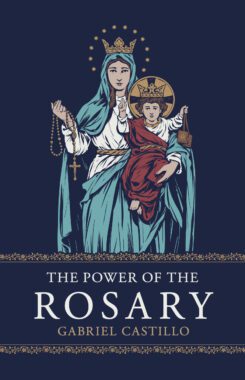
This article on the rosary is adapted from the book The Power of the Rosary by Gabriel Castillo which is available from Sophia Institute Press.
Art for this post on the rosary from The Power of the Rosary: cover used with permission; Photo used in accordance with Fair Use practices.