A Reflection from “The Power of the Rosary” by Gabriel Castillo
When the Holy Rosary is said well, it gives Jesus and Mary more glory and is more meritorious than any other prayer.
—St. Louis De MontfortThe Rosary is the most beautiful and the richest of all prayers to the Virgin Mary; it is the prayer that touches most the heart of the Mother of God.
—Pope St. Pius XI advise you as earnestly as I can, and even adjure you not to allow a single day to pass without reciting the Rosary, which is most pleasing to God and the Blessed Virgin Mary.
—St. Francis de Sales
Shortly after my conversion, I would come across bold claims like the ones above. I accepted them and believed them, but deep down I thought they were just pious sayings. As I slowly began to mature in my faith and come to believe that Catholicism was objectively true, I realized that the saints were not just pious people. Yes, although many were simple and holy, a great number of them were intellectual giants, Doctors of the Church, and masters of mystical theology and spirituality. It was these spiritual giants who were great devotees and champions of the Rosary.
I too have now come to believe in the power and efficacy of the Rosary, not based on piety but on theology. I am convinced that truly a greater prayer does not exist. G. K. Chesterton said there were thousands of reasons to be Catholic, and all of them amount to this: It is true.
The same sentiment holds about the Rosary. There are many reasons to pray it, but ultimately only one reason: It is the best. Pope Leo XIII said, “We think the best and most effective way to Mary’s favor lies in the Rosary.” All the greatest saints agree that the Rosary is theological genius, a master class in spirituality. God willing, you too will be convinced that the Rosary is truly the greatest prayer—not just for Roman Catholics but for everyone.
Part of the reason I was slow to really be convinced of the truth behind these bold claims from the saints was that, when I prayed the Rosary, it didn’t always feel good. Among my peers it felt like there was a kind of devotional relativism. They would say things like, “It doesn’t really matter how you pray, just as long as you pray.” I was confused, and I had questions. If the Rosary is so great, why is it difficult? It doesn’t feel like anything is happening. Am I even doing this right? We will examine all of that. Together, we will build your devotion on a solid foundation of truth, so that you will remain steadfast even in dryness and difficulty. We will also explore how to pray the Rosary “well.”
First, in order to properly appreciate the Rosary—or any devotion for that matter—and adequately evaluate its power and perfection, we must first examine the goal of the spiritual life. What is the end game? In any aspect of life, if you want to succeed at something—business, fitness, holiness—you must start with the end in mind. Only after examining the goal can we make clear choices about what steps are needed to succeed. Anybody can learn how to pray the Rosary, but if we are going to persevere in this devotion, we must be convicted of the why behind it.
Theosis: The Goal of the Spiritual Life
The deepest longing of the human heart is true and lasting happiness. God created us with an eternal ache that no earthly thing can satisfy. This ache can be satisfied only by God, who wills to play an intimate and personal role in all of our lives.
Often people turn to religion to heal something or to get a sentimental feeling, but they don’t surrender every aspect of their lives to Christ in a personal way. Even within Christianity, some people reduce Christ’s saving work to “fire insurance,” ensuring they will not be punished in the afterlife. God’s plan for salvation is so much more profound than a bargain or an exchange. The intimate union God wants with us is so deep that all through Sacred Scripture the highest analogy used is the union of a married couple who are no longer two but one. St. Paul said, “It is no longer I who live, but it is Christ who lives in me” (Gal. 2:20). St. Peter takes it further: We will “share in the divine nature” (2 Pet. 1:4). St. Athanasius echoes the same: “God became a man so that Man might become like God.”
This is essential. The end of Christianity is union with God: to become one with Christ, to resemble Him, to let Him live and love and act through you. Theological terms for this include theosis, divinization, deification, and sanctification; in simpler terms: You become holy. God reveals Himself to you, and you become like Him. It sounds like you are losing yourself, but that is the great paradox of Christianity: From death comes life. The more you die to yourself, the more alive you become. And the incredible thing is, the holier you become, the more intensely yourself you become: more alive, more vibrant, more of who you were meant to be.
As you begin this journey of theosis, what will happen is that the grace that God is pouring into your life will begin to pour out into the life of your family. Through you, Christ enters the home, the workplace, the school. Other people see a person fully alive, a person who is happy. To be holy and to be happy are synonymous. Only those who are holy can be truly happy, because to be holy is to discover God’s plan and purpose for your life.
The process of becoming holy isn’t arbitrary, and your progress cannot be measured by how you feel. So many people are misled and taught to go off feelings. To make decisions based solely on your feelings is a recipe for disaster, because part of the process is striping away self-love and self-will in exchange for God’s love and God’s will. Christ said, if you wish to be my disciple you must deny yourself (see Matt. 16:24).
What does all this have to do with the Rosary? Everything. You will soon see that in the Rosary there is a stripping away of your self. There is a death and self-denial, but what dies is the worst, most selfish part of ourselves, and what is left is beautiful—and well disposed. We are given the grace to know God’s will and the strength to do it. He fills us with His love and divine life. This is why it is so important to understand the Rosary. Starting with the end in mind, being convicted of the theology and intellectual truths, will help you to persevere in the Rosary in times of dryness and desolation.
Theosis, union with God, is becoming a saint. It is the only path to Heaven. Every person in Heaven is a saint, and Heaven is our ultimate purpose. God and His Church decide who will be canonized as examples for the Church, but we should all strive to live lives worthy of emulation. You must strive to become the person God created you to be. To become a saint is a lifelong process of purification of our will, training in virtue, and, most importantly, participating in a divine action. The Rosary will act as a force multiplier in every part of the process of sanctification.
+
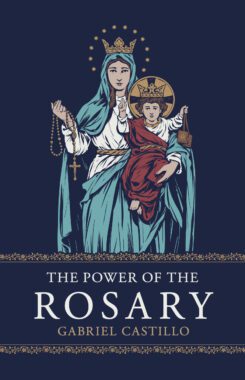
This article on the rosary is adapted from the book The Power of the Rosary by Gabriel Castillo which is available from Sophia Institute Press.
Art for this post on a reflection from The Power of the Rosary: cover used with permission; Photo used in accordance with Fair Use practices.