My favorite place in this world is a hermitage, preferably one deep in the woods or maybe alone on a high mountain somewhere overlooking a lake. The reason why I love a hermitage is because it is the only place in this world that I found where I can truly be alone with God. Having lived in a hermitage for several years, and after having spent many days and weeks in the hermitage prior to my time of living in one, I truly believe that a hermitage is a foretaste of heaven. There, in that sacred space, one is easily oriented towards the presence of God.
Since I left the hermitage, I have often been asked how I maintain a contemplative life now that I am fully immersed back in apostolic life. My answer is always the same: Mary. In fact, the presence of Mary is now my hermitage. If it is true that a hermitage is a physical space that is meant to orient us more deeply to the presence of God in our hearts, is this not true, and even more so, of the presence of Mary? St. Maximilian Kolbe once said that “the more one is in contact with the Immaculata, the more abundant will his interior life be.” Hence, the more deeply we live with Mary, the closer we will be to God. The reason, of course, is that Mary, unlike anyone or anything else, orients us perfectly towards the presence of God. Therefore, she is that hermitage in which, if we truly desire holiness, we would be wise to dwell.
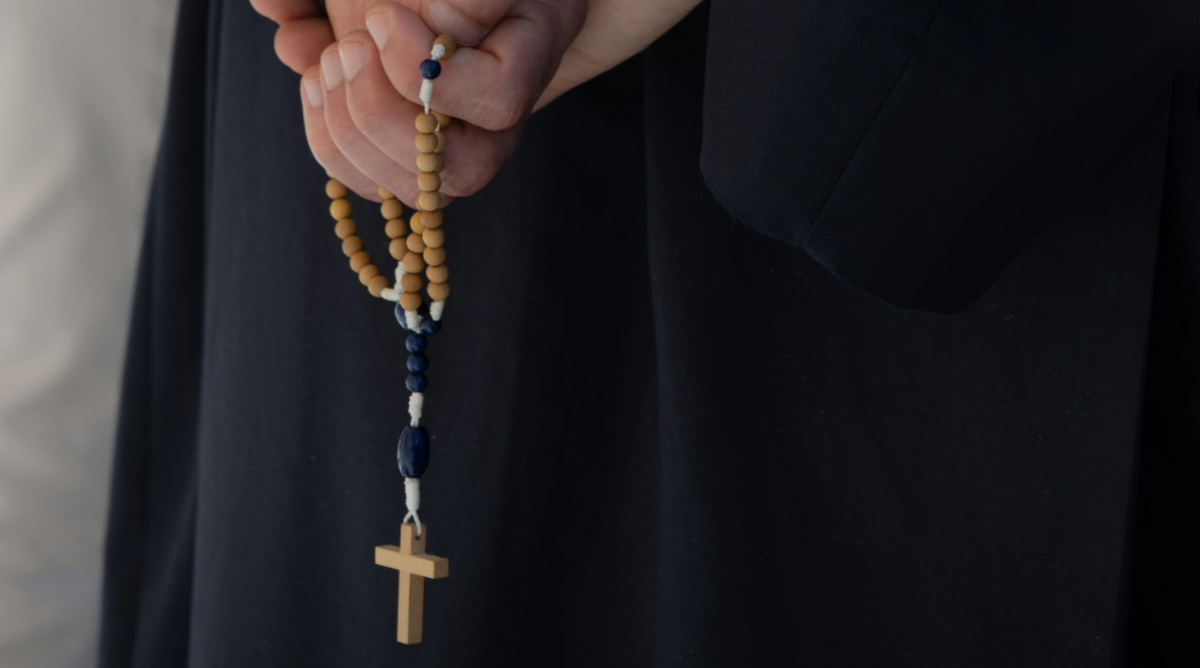
How a person lives deeply with Mary will obviously look different in each person’s life. However, this is what my Marian hermitage looks like in the midst of apostolic life. In my times of solitary prayer and Eucharistic adoration, praying the rosary always opens my mind and heart more fully to the mystery and beauty of God. It gradually quiets the incessant chatter within me, thus enabling me to listen more attentively to God’s presence in the depths of my soul. In other words, the rosary leads me to interior silence and stillness, where with Her, I am able to gaze lovingly on the Lord.
As wonderful and necessary as those times of solitary prayer are, they comprise relatively little, about four hours a day for me in my religious community, of my whole day. What about the remaining 20 hours of the day? How does one remain oriented towards the presence of God in the midst of activity? Personally, the greatest contemplative practice I have found is to quietly and prayerfully say the holy name of Mary in the midst of all the various activities I am involved in. Whether I am preaching, writing, or speaking with someone, I try to have the Holy Name of Mary echoing within my heart.
The reasons are numerous for why one could and should recite her name often. For example, St. Germanus says the following: “As breathing is a sign of life, so also is the frequent pronunciation of the name of Mary a sign either of the life of divine grace, or that it will soon come; for this powerful name has in it the virtue of obtaining help and life for him who invokes it devoutly.” I have recognized that all my apostolic endeavors occur, not perfectly of course, but much more smoothly, when the holy name of Mary is echoing with my heart.
The Church, both in her wisdom and great love for the Mother of God, has written a beautiful votive Mass entitled “The Holy Name of the Blessed Virgin Mary.” In this liturgy, the Church teaches that the name of the Blessed Virgin Mary is a cause of celebration for primarily four reasons.
First, the name of Mary is a name of honor. Mary, though fully human, is not merely an ordinary creature. She was, as Pope Pius IX teaches in his Papal encyclical Ineffabilis Deus, predestined by the Father to be the mother of his Son in whom he would become incarnate and be born into this world. So unique is Mary and worthy of honor that Pope Pius IX writes that “under God, one cannot imagine anything greater, and which, outside of God, no mind can succeed in comprehending fully.” Truly then, the name of Mary is a name of honor.
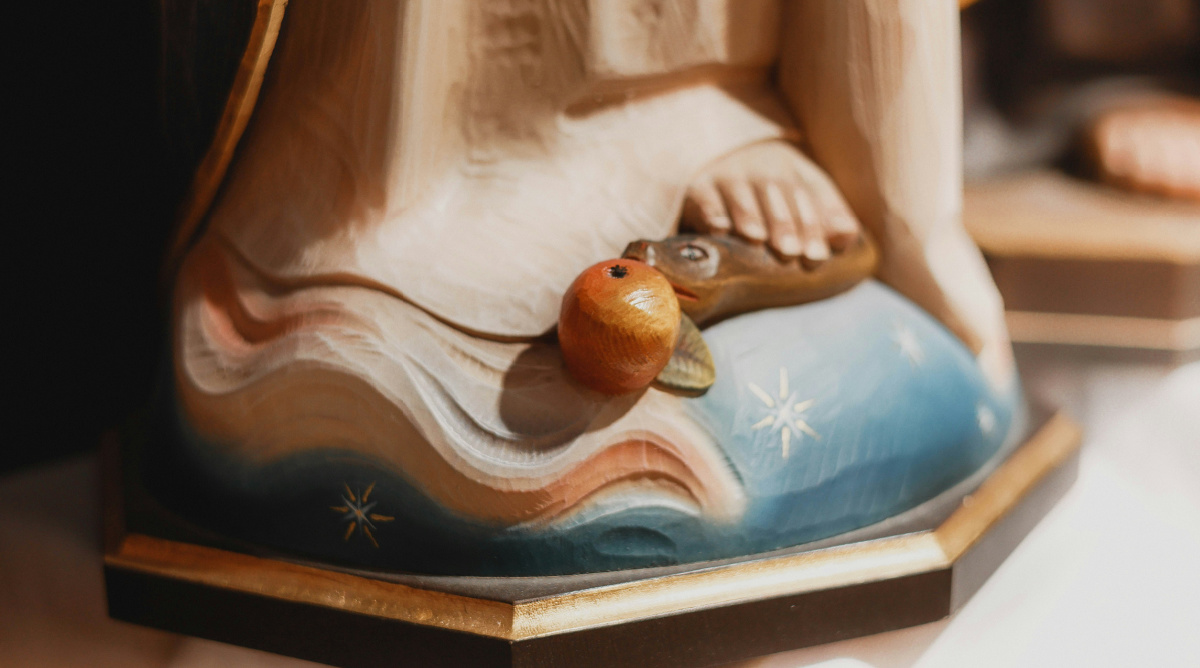
Second, the name of Mary is a holy name. The angel Gabriel greets her as “full of grace” (Lk 1:28) and as one who has “found favor with God,” (Lk 1:30) and so she conceived and gave birth to the Son of God (Luke 1:31). After the name of Jesus, there is no other name more holy, pure, and efficacious than the name of Mary. She is, as she affirmed at Lourdes to St. Bernadette, the Immaculate Conception, which is a grace and privilege given to no other creature that essentially affirms the unique holiness that belongs solely to her. Truly then, the name of Mary is a holy name.
Third, the name of Mary is a maternal name. While Jesus was dying on the cross, he said to Mary, “Woman, behold, your son! (Jn 19:26). It would be impossible to articulate how extraordinary it is to even say that God has a mother. What is perhaps even more extraordinary is the love and tenderness that Jesus had for her. He depended on her maternal care (Lk 2:7), obeyed her (Lk 2:51, Jn 27), and even praised her as the greatest disciple (Mt: 12:50, Lk:1:38). Yet Jesus didn’t keep Mary for himself. His very last act as he was dying on the cross was to entrust His Mother to us through the apostle John (Jn 19:27). Jesus wants us, not only to know and love the sweetness of his mother, but like him, he wants us to be nurtured and formed by her. Truly then, the name of Mary is a maternal name.
Finally, the name of Mary is a name responsive to need. Mary is not a mother who is overwhelmed by the demands of motherhood, nor is she a mother consumed by fear, anxiety, or self-absorption, all of which would make her incapable of noticing and attending to the needs of her children. Rather, Mary is the mother who is never tired, always at peace, and whose greatest concern is our own sanctification. Hence, she is always available to us and always responds to our needs. St. Maximilian Kolbe expresses this most clearly when, in his prayer called Act of total consecration to the Immaculate, he writes in speaking to Mary: “Wherever you enter, you obtain the grace of conversion and sanctification, since it is through your hands that all graces come to us from the Most Sacred Heart of Jesus.” Truly then, the name of Mary is an attentive and responsive name.
Just as there is no other creature like Mary, so too among creatures there is no name so beautiful, holy, and pure as the name of Mary. To recite her name in the depths of our hearts is to place ourselves in the arms of not only our mother, but the Mother of God. Since nobody knows the Son like the Mother, it is there in her arms where we will be turned most fully towards her Son.
Despite how busy our lives may be, most of us can prayerfully say her name throughout the day while we are working, cleaning, cooking, or whatever other responsibilities our individual vocations might have us doing. The more often we do so, we will be living, not in an actual hermitage alone in the woods, but more deeply in the recesses of our own hearts where the Most Holy Trinity dwells. The presence of Mary then is truly a hermitage, a place so quiet, still, and prayerful that the more deeply we enter there, the more deeply we can live with God and find rest, even amid the busyness of this life.
Image: Unsplash