The Problem with “Praying to Saints”
At one time in my life I viewed Christians as shallow people blindly following silly rules. As I was to discover, these perceptions were not only wrong, they were worlds away from reality. The root cause of my misconception was my confident ignorance. Until I allowed Christians to speak to me and define their faith in their words, I was unable to get anywhere near the truth.
As a Protestant, I had the same problem when examining teachings of the Catholic Church. Even after more than a decade of study, one-hundred percent of my perceptions were framed, not by understanding how the Catholic Church defined or explained its own beliefs, but by how Protestants defined and explained them. With that as a back-drop, let’s look at a common concern with the idea of “praying” to the Saints.
First of all the word “prayer” was a huge stumbling block for me. It is very important for Catholics to understand that in the Protestant world, the word “prayer” is never used for any other purpose than to describe communication with God. So to hear someone was “praying” to a Saint easily sounded like sacrilege.
A similarly sized challenge for the Catholic is finding alternative words to describe this preternatural conversation. No Protestant has an issue with asking a friend to pray for them. The scenario of a prayer request to an earthly friend is easily described because the exchange happens in the natural realm. For example, “I talked with Bill and asked him to pray for me.” If a Catholic were to use natural-realm language like this to describe the expression of their needs to someone beyond this life, for obvious reasons, it would sound odd and incomprehensible. The difficulty is that aside from the word “prayer” what word could one use to describe this exchange? I can’t think of one that captures the true nature of the Catholic’s supernatural supplication. So, one is then forced into either falsely defining reality for the Catholic, or, allowing them to define what they mean by what they say.
An honest inquiry reveals that the phrase “prayer to” as defined by Catholicism in this context, can be accurately translated like this, “I sought to engage Saint Catherine to intercede on my behalf.” Now, any reasonable person would find this an odd and circumlocutious utterance. Instead, a Catholic achieves the same meaning from the efficient expression, “I prayed to Saint Catherine.” To a Catholic this does not mean that Saint Catherine, any more than Bill in the example above, takes the place of God. What it does mean is that Saint Catherine loves God, is a sister in Christ, cares about the person, and will likely intercede for them effectively. No more, no less.
So, if we accept a purely Protestant definition of a contextually Catholic use of a word or phrase, we end up with a contrived pseudosacrilege. If we use a Catholic definition in a Catholic context, we end up with something quite reasonable and biblically sound.
Unfortunately, the errant interpretive method outlined above is very common to Protestant evaluations of Catholic doctrine. This disappointing approach is unworthy of the often helpful perspectives Protestants bring to doctrinal discourse on important issues in the Christian life.
Seek Him – Find Him – Follow Him
Dan
+
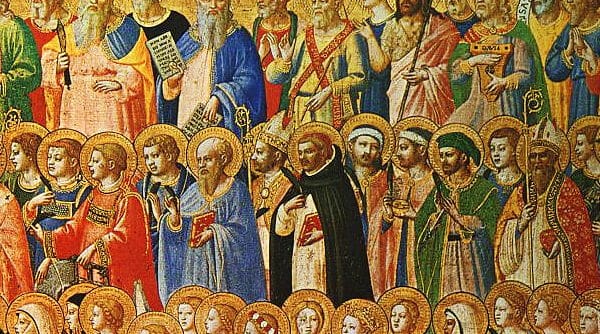
Art for this post on the problem of “praying to saints”: St. Thomas Aquinas detail of All Saints – The Forerunners of Christ with Saints and Martyrs, Fra Angelico, 15th century about 1423-24, PD-US author’s life plus 100 years or less, Wikimedia Commons.