Much has been made regarding the difference between natural gifts ( sometimes called talents) and charisms ( spiritual gifts). My purpose here is not to merely list those distinctions, or to argue that these types of gifts should not be clearly distinguished from each other. Rather, I propose that there is a scriptural and sacrificial nexus where natural gifts can be offered to the discretion and will of Divine Providence as potential charisms. It is my contention that the ultimate sanctity to which we are each called may well hinge to some degree on our ability and willingness to seek that nexus.
Natural Gifts
Natural gifts, of course, are in the order of nature and often inherited. They can often be easily discerned by common experience. Someone can clearly have a beautiful singing voice or be able to hit a baseball a country mile. Such gifts are very often inherited, but can certainly be further developed through practice. While they are often offered to others, that is not an essential aspect of their nature. Someone’s ability to play the piano, for instance, is not lessened if he only plays in private.
Natural talents have at least an initial seed of natural ability but can, of course, be further developed through training and education. Without such training, that natural talent will remain stunted at some preliminary or basic level. I remember having an early instinct for playing drums or the piano, but I never developed them through training. Consequently, I poke at piano keys and tap at drums here and there to amused looks. I also recall having an early ability to draw when I was in the fourth grade. However, thanks to no further training in drawing, I can confidently state that I can still only draw very well compared to most fourth graders.
While natural gifts are wonderful gifts from God, they must initially be distinguished from charisms because they must never be confused with them. By definition, natural gifts are limited to the natural world and our lives in this natural world. The greatest singing voice, ability to shoot a basketball, or wonderful artistic talent does not transcend death.
Just as such talents can bring great beauty, they can also be used as tools of sin or evil. Singing vulgar songs, painting obscene images, and giving powerful public speeches moving the audience to sin are obvious examples of natural gifts used for evil. Obviously, sinful uses of natural gifts are a distortion and a corruption of God’s gifts and therefore a further, even more sinister sin.
Natural Gifts are Ultimately Limited
The best way to summarize natural gifts is to describe them as limited. They can bring great beauty and satisfaction in this world to both ourselves and others, but they can also bring downfall and sin if improperly used. They can be developed through education and training, but they do not guarantee happiness or true fulfillment, much less salvation, to anyone. Suffice it to say that while we can be grateful to God for the natural gifts we do have, the sanctity that He aspires for us dictates that we should seek something much more.
Spiritual Charisms
The word “Charism” is Greek for “gratuitous gift”. Charisms are gratuitous gifts from God always given for the purpose of building up the Church and the needs of the world ( 1 Cor 14:3) Since they are literally stones directed at building up the body of Christ, they are intrinsic to that body and cannot be discerned apart from that body.
Charisms are special abilities given by the Holy Spirit that enable the recipients to be powerful channels of God’s love and presence. They are manifestations of the Spirit (1 Cor 12:7) whose purpose, nature, and fulfillment are rooted in being used for the service of others ( CCC 2003). In other words, a charism kept to oneself is a charism wasted and misused. By definition, then, a charism is a supernatural gift with a sacred responsibility no longer confined to individual whim or preference.
The Parable of The Talents ( Mt 25:14-30) reminds us that gifts conferred by our Master carry with them the interest of being multiplied through use for the Master’s intended purpose. Consequently, a master seeking merely financial profit, as is seemingly or partially implied in the parable, wants the servant to multiply said financial profit.
However, as is so often the case with Our Lord’s parables, there is much more to the lesson than mere surface appearances. Ultimately, this parable should remind us that in order to serve our Master well, we must first know our Master’s nature and purpose and then work diligently, eagerly, and even passionately to multiply and fulfill that purpose. The punished servant was not about his master’s purpose and certainly did not work at all to develop, multiply, much less fulfill that purpose.
Rather, that punished servant was all about fear, mistrust, and self. He was more concerned with avoiding loss than seeking gain because he neither knew nor trusted his master. If he knew his master would reward his efforts to respect the master’s purpose regardless of the ultimate result, he would have at least tried his best to develop the gift given to him.
It is often said that we cannot truly love God unless we seek to know Him. Likewise, we cannot truly serve God through our charism(s) unless we know God and what He wants us to do with those charisms. One thing is for sure: unlike natural gifts, charisms must be used in the service of God and others to be fulfilled and serve their purpose.
A common aspect of such charisms is that their impact and consequences can often be extraordinary, much more transcendent than their mere natural or expected basis. Many cite examples of average singers or musicians who move crowds to tears through their performances in praise of God, the Blessed Mother, and our Faith. Such performers are certainly not the most naturally talented, yet their impact transcends their actual talent. Such transcendence is the essence of the supernatural aspect of their gifts. They do not follow our human expectations or measures. Their only true measure is how they bring souls to the Kingdom of God.
General Charism Lists
The lists of charisms are many and easily found, but certainly they can all be categorized into such more general groups such as leadership ( teaching, pastoral, exhortation, administration), Evangelization ( preaching, inspiring, passion for spreading salvation ), Service/Ministry ( charity, helping, works of mercy), Prophecy and Prayer ( love of Scripture and dedication to prayer and contemplation, ability to guide and inspire), and Healing ( prayer and working toward physical and spiritual healing). I have seen lists containing as many as 26-30 specific charisms.
My purpose here is not to list every single charism possible nor to present a how-to recipe for discerning either natural, much less charism, gifts. Rather, my concern is to propose a higher aspiration while recognizing the distinction between these two types of gifts while exhorting each of us to transcend such mere distinctions.
The Scriptural and Sacrificial Nexus Between Natural Gifts and Charisms
We are each called to be saints ( Rom 1:7), and inherent in that call is the use of the gifts God has given us toward the sanctification of souls, both that of others and ourselves. Unless a God given gift is used to bring others and ourselves closer to God, that gift is not being used to its maximum potential and purpose.
It is common for people to describe their talents as their own. Consequently, people will speak of “my singing” , “my guitar playing”, or “my drawing”. While such descriptions and attitudes may suffice for those steeped and chained to natural, temporal aspirations, they will not do for the soul seeking sanctification.
The proposal here is that anyone aspiring to the sanctity to which we are all called must offer his or her natural talents to God Almighty as sacrificial offerings to be consumed by God’s providence and purpose in the service of His Kingdom. By doing so, we are not pretending that our natural talents are the same or equal to whatever charisms the Holy Spirit may deem to give us. We are merely offering whatever natural talents we have as fuel to further that supernatural purpose.
Grace perfects nature, and so God’s grace in conferring certain charisms to each of us can certainly raise the natural gifts He has lent to us, if it is His will, into charisms or to enhance the charisms we already have. While charisms are not merely the natural developments of natural talents, those very same natural talents, offered as sacrifice to Divine Providence, can support or further enhance the charisms we have been given.
Conclusion
Through our Baptism, we have each been given at least one charism, if not more. It is our duty to a loving and merciful God to discern and develop that charism as best we can trusting that the Holy Spirit will help us best use it in the service of The Kingdom of God.
Those charisms certainly belong to God and not us. They are gratuitously given by a generous and loving God intended for the purpose of serving and growing His Kingdom. While natural gifts do not necessarily carry the same responsibility and inherent duty, the soul seeking sanctification can do well to offer his or her natural gifts to the same standard.
Let each of us be like noble Abel, offering the humble, natural gifts God has lent to us as a loving sacrifice in the service of God’s plan. Perhaps God can raise those natural gifts to charisms, or use them to further enhance our ability to use whatever charisms we already have.
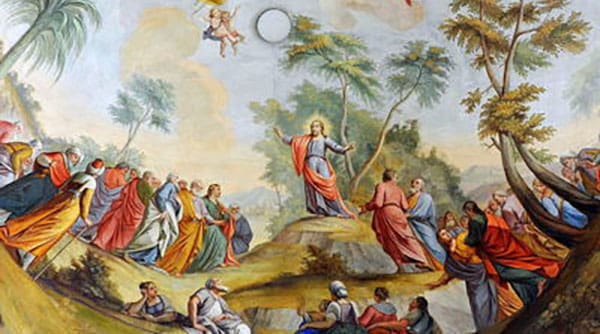
Dan Burke has reminded us that we are not called to multiply the fish and loaves, but merely to offer them for Christ to do the multiplying. Let us see our natural talents as meager fish and loaves, already belonging the Lord, offered back and thus sanctified either as charisms or support for the charisms we already possess.
____________________________________________________________________
Image: Unsplash