The Paradox of Holiness and Communion
To be holy is to be set apart. To be in communion is to be in solidarity with one another. Prayer both sets us apart and establishes us in a deeper communion. It is a paradox. Although this mystery is not completely solvable, one hint is the relational dimension of prayer. It is ordered to a real friendship with the all holy God.
In asserting this, the paradox in question can never be simply an intellectual puzzle – it is existential and evokes a response. This friendship ‘sets us a part’ in the sense that we make God the priority of our heart and allow Him who is not of this world to become the life-principle of our soul. This means we are in a sense dead to the things of this life or at least not animated by them. Here, this “out of this world” orientation of Christianity can be disconcerting. Sometimes we struggle with a fear that if we really begin to pray, we might lose out on some beautiful things in this world. But living by faith does not mean that Christians care any less about the affairs of this world nor do they enjoy life any less, and this is especially true when it comes to our friends including all those the Lord has solemnly entrusted to us and to whom we are likewise entrusted for this brief time we have together in this life.
This is where the paradox comes in. Even though God’s love orients us to a life beyond this world and sometimes away from some apparent forms of communion this world recognizes, the net effect of this new orientation is that Christians are free to be even more engaged in the lives of others. This is because God is love – the deeper our communion with Him, the deeper our solidarity with those we love and the greater our ability to love. Such love is not limited by our human frailty. It is a divine gift and charged with the power of the Holy Spirit. By continually entering into the love of God through prayer, Christians discover new capacities to love those they hold most dear, and they experience a deeper communion with one another.
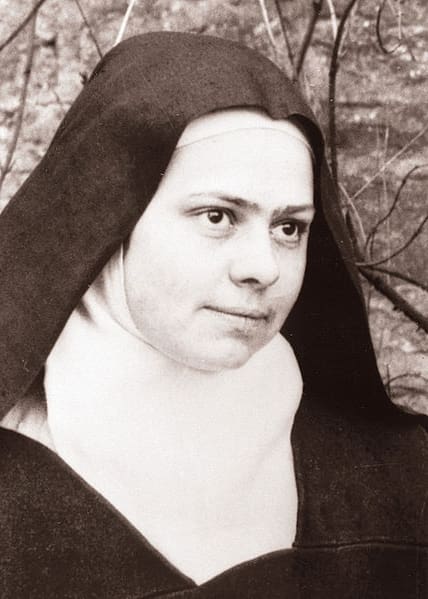 This paradox is taken up by Blessed Elisabeth of the Trinity who often wrote to encourage friends to love prayer. One letter suggests that prayer should not be limited to any quantity of memorized formulas that one mindlessly races through. It proposes a more authentic, a more personal, and a more consuming kind of prayer. Elisabeth, in fact, envisions a form of prayer which permeates every moment of one’s life. She explains it as a ceaseless occupation of the heart, “the raising of the soul to God through all things.” In this same letter, she asserts that if we engage such ceaseless prayer it “establishes us in a kind of continual communion with the Holy Trinity.” In this communion with the Trinity, we also find a spiritual solidarity with one another, a “meeting of our souls.” By ceaselessly raising our soul to God, we enter “more deeply into ourselves” “where the Father, the Son and the Holy Spirit dwell” and, she claims “in Them we will be One.” (L 252)
Art: Face portrait of Elisabeth of the Trinity [mirror image Portrait visage d’Elisabeth de la Trinité], Willuconquer, undated, CC, Wikimedia Commons.
Editor’s Note: For more of Anthony’s insights on prayer, don’t miss his book, Hidden Mountain Secret Garden, an experience like no other. Anthony has an unusually profound understanding of mystical theology and lives a life of deep prayer. Among his many accomplishments and responsibilities, Dr. Lilles now teaches theology for the Avila Institute.