In my last article, Why No One Is Beyond Hope, highlighted Rule 1 of St. Ignatius’ First Week Rules for the Discernment of Spirits. To those who have given themselves to a life of sin, Ignatius tells us, the enemy proposes one pleasure after another to keep them in their sins, while the good spirit stings their conscience to induce them to change course.
If such a person turns from sin and toward God, the activity of the spirits reverses. As Ignatius tells us in Rule 2, the bad spirit begins to “bite, sadden, and place obstacles,” while the good spirit gives “courage and strength, consolations, tears, inspirations and quiet” so that the person will go forward in doing good.
Ignatius learned these dynamics from his own experience. For some time after his conversion, he experienced consolation almost uninterruptedly. According to his autobiography, he “persisted almost in one identical interior state, with largely unvarying happiness,” until one day, upon entering a church, he had an experience that unnerved him. The impending difficulties of his new way of life presented themselves, as if it were being said inside his soul: “How are you going to be able to stand this life the seventy years you’re meant to live?”
Although Ignatius quickly resisted this movement, he began to recognize such thoughts as a tactic that the enemy uses to “place obstacles” before those moving from good to better: he plays on their imagination to produce an exaggerated fear of the future. Regarding this fear, Ignatius said, “[The enemy] has us believe that as a result of the hardships he sets before us, we are to live a life longer and more drawn-out than ever a human being lived.” As we noted in the June forum posts on the IDI website, these false reasonings often begin with the words, “What if”: “What if my family or my friends reject me when they see that I’ve changed?” “What if I commit myself to regular prayer and I just can’t keep it up?” “What if God keeps asking me for more and more?”
Author Hannah Hurnard speaks to this type of fear in Chapter 11 of her novel Hinds’ Feet on High Places. The main character, “Much-Afraid,” is warned by her shepherd-guide of the obstacles that will be wielded by her adversary, “Craven Fear.” “Much-Afraid,” the Shepherd says, “don’t ever allow yourself to begin trying to picture what it will be like. Believe me, when you get to the places which you dread, you will find that they are as different as possible from what you have imagined . . . and if you ever let Craven Fear begin painting a picture on the screen of your imagination, you will walk with fear and trembling and agony, where no fear is.”
The Shepherd’s words highlight the importance of immediately recognizing such desolating thoughts and acting against them through prayer and other spiritual exercises. I will suggest one kind of prayer that I have found very valuable at such moments.
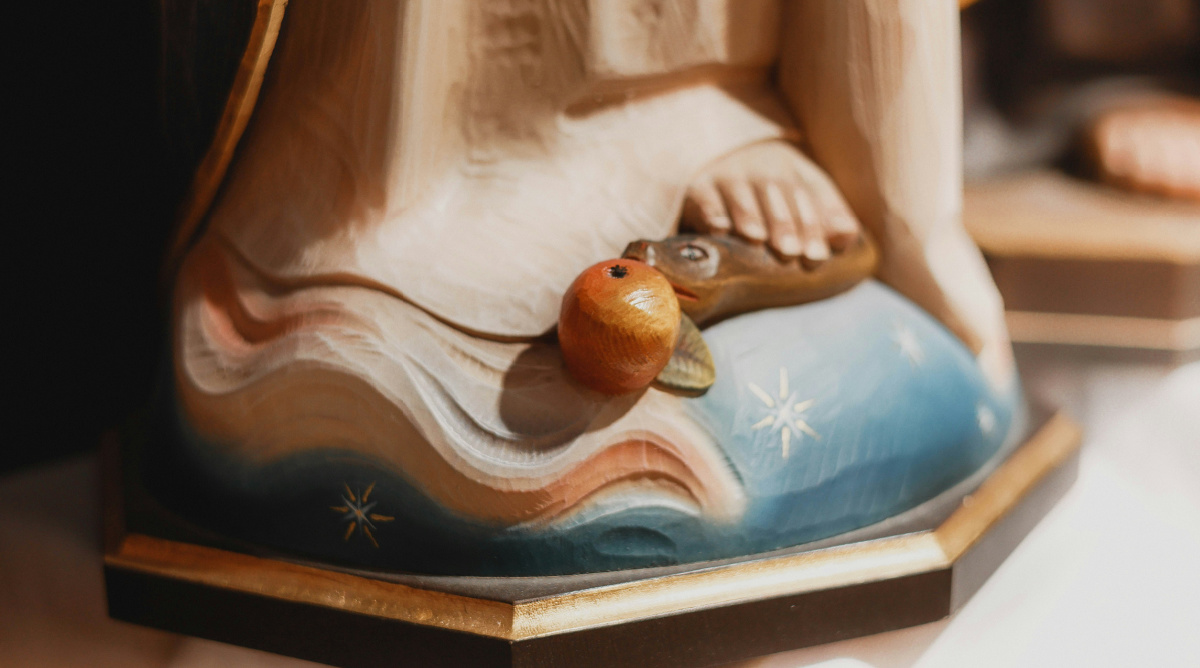
During a homily about Mary at a recent children’s Mass, a priest friend of mine asked the children, “Why do you run to your mother when you’re scared?” They gave various answers from the ridiculous to the sublime, until one child gave an answer that pierced the priest to his heart: “She tells me the monsters aren’t real.” When the enemy begins to project exaggerated fears onto the screen of our imagination, we do well to follow the advice of St. Bernard of Clairvaux: “If temptation storms, or you fall upon the rocks of tribulation, look to the star: call upon Mary.” From such prayer, our path of acting against the desolation can begin. In the rules that follow, especially Rule 6, Ignatius teaches us how to do so.
That the enemy exaggerates the difficulties of advancing in the spiritual life does not mean that the road ahead will be free of suffering. My child, when you come to serve the Lord, prepare yourself for trials (Sirach 2:1). But God will always be present, and consolation will return. “With this divine consolation,” Ignatius says, “all hardships are ultimately pleasure, all fatigues rest. For anyone who proceeds with this interior fervor, warmth and consolation, there is no load so great that it does not seem light to them, nor any penance or other hardship so great that it is not very sweet.”
In times of desolation, Mary is there to strengthen us and to remind us of the Shepherd’s words to Much-Afraid: “When you get to the places which you dread, you will find them as different as possible from what you have imagined.” And we will have no doubt that the journey was worth it.
___________________________________________________________________________
This post was first published on the Ignatian Disernment Institute and is reprinted here with permission.
Image: Unsplash