“His gaze is the still point.”
This was recently penned by a fellow author on Substack, referring to the face of Christ.1 I love that line. It reminds me of a quote from St. Thérèse of Lisieux, “Your face is my only homeland.”2 I have pondered this saint’s phrase for many years.
Homeland, what does that mean? The place you belong, the place where you feel at peace, the place where you are known; all of these are aspects of what one associates with one’s homeland. For Thérèse, Jesus’s face was all of these things.
But why does she choose His face? It is true that veneration of the Holy Face began as a devotion given to Sr. Mary of St. Peter, a Carmelite nun in Tours, France, between 1843 and 1847.3 This devotion, which was an act of reparation for blasphemy, atheism, and the desecration of Sundays, would have been propagated through the Carmels of France and Europe for several decades prior to Thérèse’s entrance into the Carmel of Lisieux. But beyond simply desiring to make reparations, I believe there is a deeper reason Thérèse chose to include the Holy Face in her religious name. St. Thérèse was captivated by The Holy Face.
It represented God’s entire person. In doing a word search in both the Old and New Testaments for the word face, I came to understand that it has multiple meanings. It can mean the literal face, but it is also used metaphorically to denote the whole person, including one’s temperament, attitude, and entire being. In this sense, it is a relational word. Face denotes presence.
⎮ Face denotes presence. ⎮
An example of this is found in Exodus 33:11, “And the Lord spoke to Moses face-to-face, as a man is wont to speak to his friend.” Moses was in the presence of God in an intimate relationship. Face-to-face denotes a measure of equality. Though no creature could ever be equal to God, God humbled himself on Mount Sinai and allowed Moses to relate to him as a friend. St. Thérèse desired that friendship and took the Holy Face as part of her religious name precisely because she desired to be associated with and conformed to the person she loved most, Jesus Christ.
In the face, we find the eyes. What does scripture tell us about the eyes? Matthew 6:22 states that the eyes are the lamp of the body. The eyes shine forth what is in the soul. I appreciate the poetry of the Roman philosopher, Cicero, who wrote, “The face is the picture of the mind, and the eyes are its interpreter.”4 This statement approaches what is meant by gaze.
⎮ “The face is the picture of the mind, and the eyes are its interpreter.” ⎮
To gaze at someone is to perceive with the sense of sight. When two people gaze at one another, they take one another into themselves through their eyes. When eyes meet, there is an exchange of understanding. But in my experience, to gaze at someone goes far beyond merely seeing them with your eyes. There is another sense, a spiritual one if you will, that allows you to experience that person on the invisible plane. Most of the time, people are unaware of this other sense. They are too busy; it takes time, it takes slow time, still time to perceive on this level. To see in this manner is the deeper meaning of what it means to gaze at another. It is a heart-to-heart, a spirit-to-spirit encounter.
If Christ’s gaze is the still point, how do we encounter His gaze, this heart-to-heart, soul-to-soul, face-to-face encounter? Surely Christ is gazing at us every moment of our lives. But how do we return that gaze? Can we, too, speak with Him as one would a cherished friend, as Moses did, as St. Thérèse did?
⎮ Surely Christ is gazing at us every moment of our lives. ⎮
He is the Majestic King of the Universe in whom all things hold together, and without whom was made nothing that was made. How can we mere children of dust dare to meet His gaze? The incarnation answers that question.
Jesus tells Andrew that He is the face of the Father. Jesus came to gaze upon us so that we might meet the Father’s gaze and find within it the source of all we are. In coming to know Jesus through scripture, mental prayer, and Christian meditation in the authentic Catholic mystical tradition, we come to know His face, His person.
Part of that tradition, which is beginning to be recaptured in the West and has remained integral to the Eastern church, is the veneration of icons. The earliest icons we have are of the faces of Christ and his mother, Mary. As a student of iconography, I have had the opportunity to write a number of icons, including an icon of the face of Christ. I can tell you from my own experience that there is a knowing, on an experiential level, that comes from taking time to meditate and pray before an icon, especially writing the face of Christ.
The process is time-consuming, requiring multiple layers of paint and repeatedly retracing lines. All the while one seeks to remain in a state of meditation, repeating the Jesus prayer, “Jesus, Son of the Living God, have mercy on me a sinner,” modulating one’s breath to the inflow and outflow of the words. It is a form of discipline, and the exercise of drawing the face and imbuing it with light by layering ever lighter pigments onto the darker skin tone (sankir in Russian and proplasmos in Greek) is in itself a lesson in theology. The gilding of the halo with real gold leaf represents the uncreated light in which God dwells. The various pigments have their own theological language, which is far too complex for the scope of this article. Nevertheless, when one embarks on learning the language of icons and begins to see as the ancient Christians did, a whole new mode of encounter opens to the soul.
The eyes are the most important part of the icon. They are the “window of the soul.” The eyes are the gaze of the infinite, inviting encounter with the living God. They are intentionally enlarged to create a sense of stillness (hesychia); they emphasize spiritual wakefulness and the communication of divine grace. The gaze of an icon communicates to the viewer that they are not looking at a painting but rather being seen and known by God.
⎮ The eyes are the gaze of the infinite, inviting encounter with the living God. ⎮
There is something immediately calming about a face you love, in whom you have complete confidence in their love for you. The face of a trusted parent or friend can immediately calm you; just their smile can be enough to bring peace to your soul. An icon of the face of Christ can be that still point to an even greater magnitude. Keeping one at home or in a small niche on your office desk can provide a place to encounter Christ’s gaze.
Personally, I take a small travel-size icon of The Holy Face with me wherever I travel. I keep this same icon by my bedside, and it is the first face I gaze upon when I wake and the last I see before I go to sleep. I never want to be without the opportunity to encounter His gaze as that still point. Gazing at the Holy Face is a reminder of who He is and who I am. He is the King of the Universe and the God who became man to die for me, and I am His creature made of dust. Yet, I am beloved dust, dust that He desires to raise up above the angels to participate in the love shared by the Blessed Trinity.
I can not recommend highly enough the use of icons in one’s spiritual exercises. It is said that the saints choose you; the same goes for icons. Icons will speak differently to a variety of souls. When it comes to choosing an icon of Christ, some of the oldest I can recommend obtaining a copy of include the Pantocrator prototype, a sixth-century icon that resides in St. Catherine’s Monastery at Mt. Sinai.

Another icon, titled “Not Made by Human Hands,” or Acheiropoieta, in Greek, is another ancient icon. It is also called the Mandylion, and its origin is in the Eastern Tradition, which celebrates the gift of an image of Christ’s face on a cloth given to King Abgar of Edessa, which affected his healing. There are a number of icons that have been made copying this cloth. However, the original has been lost.5
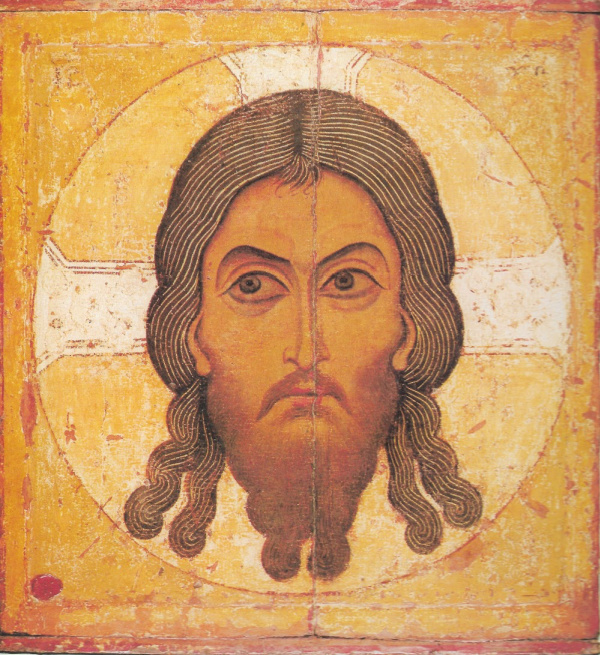
There are other icons of the face of Christ, representing his face on the veil of Veronica and icons of the “sudarium,” which is the image of the face of the resurrected Christ on the cloth that is mentioned in John’s gospel, which he and Peter found folded up neatly and laid upon the place where Jesus had been entombed.
There are many other icons of Christ that have been written throughout the centuries, each conveying various attributes of God’s nature. Finding an icon on which you can gaze and encounter Christ gazing at you can be a profound way to grow in your experiential knowledge of Christ and His love for you. I find that a combination of reading scripture, the prayers of the saints, mental prayer before the Blessed Sacrament, and fixing my gaze in veneration upon icons of His Holy Face all help me find His gaze as the still point of my soul.
“For God, who commanded the light to shine out of darkness, hath shone in our hearts, to give the light of the knowledge of the glory of God, in the face of Christ Jesus.” (2 Corinthians 4:6 Douay-Rheims 1899 American Edition)
Lord, show us Your Face, and we shall be saved.
________________________________________________________
- Claire Dwyer, Prepare for Re-entry, https://substack.com/home/post/p-194911410 ↩︎
- Saint Thérèse of Lisieux wrote the line “Your face is my only homeland” (in French: “Ta face est ma seule patrie”) in her poem “Canticle to the Holy Face” (Poem 20), which she composed for the 21st birthday of Sister Marie of the Trinity in August 1895. ↩︎
For a more thorough History of devotion to The Holy Face, see: https://theholyface.com/the-history/ ↩︎- Cicero wrote this in “Orator” (also known as Orator ad M. Brutum), a theoretical treatise on the art of public speaking and rhetoric addressed to Marcus Junius Brutus. In the original Latin, the famous quote reads: “Nam ut imago est animi voltus sic indices oculi”, which translates directly to “For as the face is the image of the soul [mind], so are the eyes its interpreters.” ↩︎
- For a fascinating history of the Mandylion, you can go here: https://www.pallasweb.com/deesis/icons-of-christ-mandylion.html ↩︎
Featured image: The author, Ruth Engelthaler, at the Icon Retreat at Avila Institute, January 2026. Photo taken by a fellow student.
This post was originally published on The Burning Bush and is reprinted here with permission.