A Reflection from “Angels of Light, Angels of Darkness” by Rev. Adam Blai
The word of the Lord came to me: Son of man, if a land sins against me by breaking faith, and I stretch out my hand against it, breaking its staff of bread and setting famine loose upon it, cutting off from it human being and beast alike—even if these three were on it, Noah, Daniel, and Job, they could only save themselves by their righteousness—oracle of the Lord God. —Ezekiel 14:12–14
Prologue
The book of Job is a very important book for understanding the relationship of Satan to God vis-à-vis mankind. This is a story about the persecution of the innocent, about how we respond when life gets rough. It was probably written between the seventh and fifth centuries B.C. The name Job in Hebrew (Iyowb, אִיּוֹב), perhaps unsurprisingly, can mean “the persecuted.”
The book begins, “In the land of Uz there was a blameless and upright man named Job, who feared God and avoided evil” (1:1). We learn in the introduction to Job that he is the wealthiest man in the region and that he has seven sons and three daughters.
When the text says Job “feared God,” the Hebrew word translated “God” is elohim (אֱלֹהִים), a plural masculine noun that means “gods” and likely refers to the “divine council” of God and the angelic spirits He created to help Him make decisions and run creation. Sometimes Elohim can refer to the singular creator God, and sometimes the phrase bene Elohim (sons of God) is used in Hebrew. Regardless, the idea of the angels’ being called “sons of God” is common. Whether Elohim refers to the angels or to God can sometimes be determined by context and other word usage in the same passage.
When the introduction concludes, we find ourselves in God’s throne room: “One day, when the sons of God came to present themselves before the Lord, the satan also came among them” (Job 1:6).
“Sons of God”: Again, the plural elohim is used for the divine council here, and the proper name of God is used for God: Yhwh (יְהוָה). Since the proper name of God is used in the same passage, it seems clear that elohim in this case refers to the angels or both the angels and God. We also notice that the devil is referred to as “the satan” and not “Satan” (a proper name).* In this context, satan means “an opponent” and is also a legal term for the prosecutor (or accuser) in a legal trial.
Saying “the satan also came among them” strongly implies that Satan was not a part of the divine council. The next line confirms his place: on earth. God asks this accuser where he has been, and the spirit says he has been roaming the earth, patrolling it. The Lord replies, “Have you noticed my servant Job? There is no one on earth like him, blameless and upright, fearing God and avoiding evil” (1:8).
The prosecuting spirit seems to shrug. Maybe Job is God-fearing only because God has protected him, made him wealthy, and given him a family. Maybe Job respects God and his angels because Job has a good life. In that case, the satan continues, if God strikes at Job’s possessions and family, Job will curse God to His face.
The stage is set for the test. God tells the satan to do what he pleases with all Job possesses but not to hurt Job himself. God does not smite Job himself, as the accuser seems to have been trying to get God to do. God delegates that to the satan.
What We Learn About Spiritual Combat from Job
Notice that the evil being (the satan, the accuser) needs God’s permission to inflict damage on Job or his possessions. Because he is under God’s protection, Job cannot be harmed by evil unless it is according to God’s permissive will.
We do get the strong impression that God’s protection over Job and his possessions is related to Job’s avoiding sin and worshipping God on a regular basis. We can take that as encouragement to stay in a state of grace and go to church when we are supposed to, if we want that same hedge of protection around us. Of course, we are learning in this story that God sometimes allows bad things to happen even to His devout.
The Four Calamities
The satan wastes no time in sending four calamities to harm Job, and four human messengers arrive in succession to deliver bad news to him.
First, Job learns that his oxen and donkeys were taken by raiders, and his servants there were killed (1:14–15).
A second messenger arrives and tells Job that the “fire of God” fell from heaven and consumed his sheep and the servants with them (1:16). The word translated as “God” here is, again, elohim (without the article the), so this likely means the council of Heaven, which includes God and His angels (and does not include the satan, the accuser). So either Satan caused that fire and the servant misunderstood it as coming from the elohim, or the elohim participated in the persecution of Job.
A third servant rushes in and says the camels were taken by other raiders, and those servants were killed also. Then a final messenger runs in to deliver the most devastating news: A great wind came from the desert and collapsed a house on his sons and daughters, killing them (1:17–19).
Where did this “wind” originate? In this verse, the word translated as “wind,” ruah (רוּחַ), can mean “wind,” “breath,” or “spirit.” In the ancient Near East, the desert was associated with evil spirits, where those spirits were thought to dwell. It is likely that the windstorm that caused this tragic destruction was a spirit that came in a storm from the desert. This is supported by the scriptural association of demons with the air:
You were dead in your transgressions and sins in which you once lived following the age of this world, following the ruler of the power of the air the spirit that is now at work in the disobedient. (Eph. 2:1–2)
After all this terrible news, Job tears his robe, shaves off his hair, and falls to the ground. He worships God, saying, “The Lord gave and the Lord has taken away; blessed be the name of the Lord!” (1:21). Despite all that had happened, Job did not sin, and Job did not cease honoring God. So Satan’s prediction that Job would not kneel toward God’s face, would not worship God if he suffered great loss, is proven wrong.
The Accuser Strikes at Job
Next we are back in the throne room of God. The angels come in to present themselves, and the satan intrudes on the meeting again. The same exchange happens. The roaming spirit contends that Job is still being loyal only because people value their own lives above everything else. So if God strikes at Job’s own flesh and bones, Job will fail to kneel toward God. Again, God delegates things to the satan, saying that Job is in the accuser’s hands, so long as it does not kill the man. Satan goes and figuratively strikes at Job’s person, giving him terrible boils all over his body.
Job sits in ashes (a traditional symbol of repentance toward God) and scrapes at the boils with a pottery shard. Job’s wife encourages him to curse God and die, but Job says that if one accepts the good from God, one must also accept the evil. This is perhaps the heart of the story: that we need to love God unconditionally, not only when things are going well. We need to persevere through hard times and not get angry with God and turn away from Him.
Job’s False Friends
Job’s friends come and sit with him, disturbed at how bad he looks. Job eventually complains about his situation, concluding with, “I have no peace nor ease; I have no rest, for trouble has come!” (3:26). He does not curse God, but he hopes for death instead of continued suffering.
The text that follows consists of a number of speeches from his friends and Job’s reply. It represents that internal struggle that a person might have during hard times: wanting to yell at God, bemoaning that the wicked seem to prosper and that the pious often suffer, then wanting to persevere in loving God.
There is then a poem on wisdom and understanding, pointing out that nowhere in this world but in a right relationship with God can one find wisdom and understanding. It concludes, “See: the fear of the Lord is wisdom: and avoiding evil is understanding” (28:28).
In the ensuing conversation, Job wishes for the days before, when God was blessing him.
God Responds to Job
God then speaks to Job out of a storm. God essentially asks Job if Job has the least understanding of all the things God has created, has done, and does.
Job acknowledges that God can do all things, that he spoke in error when he was complaining. Job says that, before, he had heard of God but had not seen him. Now that he has seen God, he repents for his words of complaint (42:6).
God punishes Job’s friends for their cruel words and restores Job’s prosperity, and Job’s brothers and sisters come to visit him. Job has seven new sons and three new daughters. He lives for 140 years after his trials, dying “old and full of years” (42:17).
Angels in Job
The book of Job shows us angels appearing before God to serve Him in the divine council, but also the accusing evil spirit, “the satan,” intruding and seeking from God permission to attack a devout person on earth. As we see in the book of Job, evil spirits are limited in what they can do—in fact, they can do nothing without God’s permissive will.
We see a similar dynamic in the life of St. Padre Pio, who also suffered bodily attacks from the devil despite his religious rigor and piety. He bore the afflictions of Satan as the will of God. The restoration that St. Padre Pio received was his place in Heaven, forever in peace and joy, the pains left far behind. This is our consolation as well: By following Jesus closely in this life, even the sufferings we experience serve a purpose. If we remain faithful to the Lord, no evil can touch us unless God permits it for our greater good—though we may not understand it this side of Heaven.
+
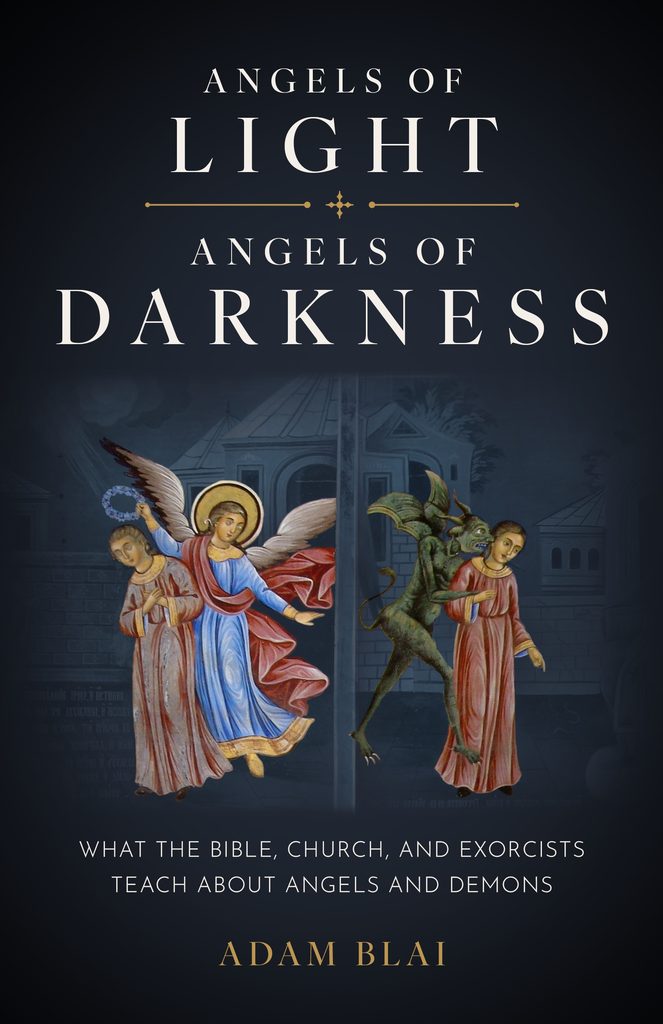
This article on Job’s trials is adapted from the book Angels of Light, Angels of Darkness by Adam Blai which is available from Sophia Institute Press.
Art for this post on a reflection from Angels of Light, Angels of Darkness: cover used with permission; Photo used in accordance with Fair Use practices.