A Reflection from “My Days are in Your Hands” by Cardinal Fernando Filoni
Long brown dress, head covered, gentle face, not too young. Almost like a vision, she walked very slowly, rhythmically, circling the Aedicule of the Holy Sepulcher. While others sat or stood in prayer, she moved gracefully, as if in contemplation, like one of the women who had participated in the burial of Jesus. She thought: what I prefer, my Lord, is hope, and she repeated it in a whisper with her lips . . . What I prefer is hope.
* * *
This was not very different from what Mary Magdalene thought when, at dawn on that first day of the week, she went to the tomb where the Master had been laid three days earlier at dusk and wondered: How will I move the large tombstone at the entrance? Joseph of Arimathea, the owner of the tomb, and others would perhaps arrive shortly afterward with a new shroud; the ointments for the final anointing were there. The other women were there with her too. What I prefer is hope; but hasn’t death definitively eliminated it? Yet Psalm 22, which Jesus had recited so many times, even on the Cross, wasn’t it the lament of an innocent man who ends confidently in liberation?
Mary’s thoughts became prayer, sobs. She now understood well what death was in the heart, that death that had torn her away from the Master, while she remembered how it had all begun with that inner and outer liberation when, according to Luke, “seven demons had gone out [of her]” (Luke 8:2). Jesus had brought her to “life,” and from then on, she had followed Him to the foot of the Cross, to the tomb toward which she was now walking.
Then suddenly she looked up and stopped, stunned. The stone was no longer blocking the entrance. How was that possible? Yet there was no one around; and when she looked inside, the tomb appeared completely empty. Her terror overwhelmed her amazement. Where was Jesus’ body? Where was it? What had happened? While others who had accompanied her returned to Jerusalem in astonishment, Mary stood there, by the tomb in her long robe, her head covered, her face gentle. Was it possible?
Then a voice shook her and a tremor ran through her whole body; that tremor that only lovers know. “Mary!” (John 20:16). The silence was as long as a hope that had not yet become certainty.
It was the Master! “Rabbouni!” My Master, is it really You, alive? Alive, with bruised feet, open wounds, bloodless.
Instinctively, she reached out to touch Him, as if to hold Him back so that the Master would stay there with her. The flesh demands this. Jesus, however, will not stay; He will leave her, and her tears will not be enough to stop the Master, nor to wash His feet.
Jesus had not, in fact, returned to His former physical life—for which He would have had to die again—but neither was He a ghost; as Joseph Ratzinger observes, this is an event that transcends the forms of life we know, and “matter itself is remolded into a new type of reality.”
In fact, the Master is changing Mary’s heart and opening it to the mystery of faith. Yes, the light of hope does not illuminate in vain: it opens the heart to the charity of the proclamation. Man’s greatest poverty is his feeling of being an orphan, the lack of God. The first charity, then, is to bring God to our brothers and sisters; not to keep Him for ourselves, as Mary was tempted to do at the beginning, but to become bearers of the good news.
She is the first missionary, sent by Christ, because—as Paul VI would write centuries later—the “multitudes have the right to know the riches of the mystery of Christ—riches in which we believe that the whole of humanity can find, in unsuspected fullness, everything that it is gropingly searching for concerning God, man and his destiny, life and death, and truth.”¹⁰ Mary had experienced this fullness in herself, and she became its voice.
Bl. Angelico, Fra Giovanni da Fiesole (1395–1455), a sublime Renaissance painter capable of capturing the feelings of his characters, depicts the scene at the tomb at the moment when Mary tries to touch the feet of the Risen Master, while Jesus gently distances Himself; He looks at Mary, and she holds her breath in a gesture of reverence and faith.
Faith and missionary charity, therefore, open the way together: “I have seen the Lord, and he has spoken to me,” she cries out, and He has told me: “Go to my brothers and tell them the truth about God”; He who is “my God and your God” (see John 20:17–18).
It is the same faith that the apostle Thomas also rediscovered in the presence of the Lord. Unlike Mary, whose love was already faith, he was granted and asked to touch the wounds: “My Lord and my God!” (John 20:28), the unbeliever-turned-believer would confess.
* * *
Here, also thought the woman who slowly made her way that evening around the Aedicule of the Holy Sepulcher, in the holiest basilica of Christendom. And she had an insight: “The faith I prefer is hope.” God, too, prefers hope.
+
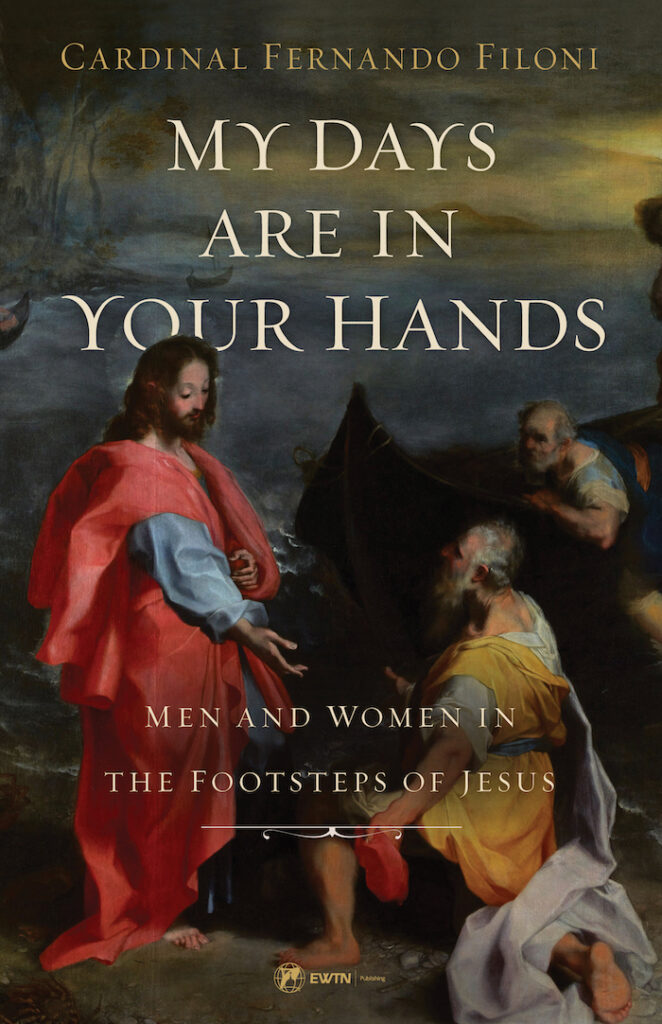
This article on St. Mary Magdalen and hope is adapted from the book My Days are in Your Hands by Cardinal Fernando Filoni which is available from Sophia Institute Press.
Art for this post on a reflection from My Days are in Your Hands: cover used with permission; Photo used in accordance with Fair Use practices.