Pope Leo has asked us to pray for priests during the month of April. In particular, he wishes us to intercede for those who are going through a moment of crisis in their vocation. Such moments can be marked by confusion, discouragement, or a sense of isolation, and yet they are also moments when grace is especially near. By inviting the whole Church to pray, the Holy Father is reminding us that no priest walks alone and that the Body of Christ bears one another’s burdens. Our prayers become a spiritual shelter around those who are struggling, helping them rediscover the strength and clarity they need to persevere in their call.
This means that the Lord desires to use your prayers to help these priests find the accompaniment and community necessary to sustain and deepen their vocation. Prayer becomes a channel through which God pours out encouragement, wisdom, and renewed zeal. And here we touch a profound mystery: when we intercede on behalf of others, we are not changing God’s mind, as though He were reluctant to help until persuaded. Rather, we are bringing to fruition what is already in the mind and heart of God. Intercession is our participation in His saving will, our cooperation with the grace He already longs to give. In this way, prayer becomes not only a plea but a profound act of communion with God’s own desires.
God does not need our prayers in order to act—He is never limited by our weakness or forgetfulness. Yet in His generosity, He chooses to use our prayers so that we might share in His outgoing mercy and love. He draws us into His work, allowing us to taste the joy of being instruments of His compassion. When we pray for priests in crisis, we are not merely observers of their struggle; we become co-workers in the mystery of their healing and renewal. This is the dignity of intercession: God invites us into His own heart, so that through our prayer, what He wills from all eternity may unfold in time.
…
If any priest is in a moment of crisis, he is facing a turning point, a moment of conversion. His moment of crisis should be our moment of conversion, too.
The conversion begins when we humbly acknowledge that we have not been as ardent in our prayers as we ought. As soon as we acknowledge this poverty, Christ is inviting us to share in His riches—for His prayer is always ardent. If we do not know how to pray from the heart, He offers us His Heart so that we might pray in its holy fire. Indeed, intercessory prayer is always a battle for the heart. If we are to fight it well, we must learn to take our stand, to stand with the Lord. Are we going to turn around and run from all that we hold sacred when our brothers are struggling? Or are we going to enter into our hearts and find the courage to stand our ground with them? If we take up this call, the Holy Father has opened up a great mystery that can rebuild the whole Church if we let it.
Prayer opens to a mystery of solidarity that sets believers apart. Once, when I was very little, a visiting group of older relatives began to sing strange songs that I had never heard before. My grandmother escorted me out of the room as the voices joined together and wistful glances found each other around the table. Later, she told me about that Resistance in the Pyrenees that rose up when a single relative was needlessly shot. Suddenly, no one could remain indifferent, no matter the sacrifice. The whole family became part of a network that helped refugees escape while gathering information and aiding other clandestine efforts at great personal cost. The great struggle against the evil of their times had set those voices apart in a solidarity of mirth and sorrow, honor and sacrifice, and something in their songs stayed with me.
These memories influence the way I see the great struggles in the Church today. We live in a time when the gift of spiritual fatherhood is under attack. Our culture, in fact, is attempting to replace this primordial institution with technology. And this has left a generation of men questioning their purpose and fundamental commitments in life. Just as a resistance movement was born after a careless abuse of power, the needless abandonment of any one of our priests is moving many of us to cultivate deeper prayer than we have ever known before. For, indeed, a crisis is a turning point, and this means it is the place where we find the Cross. Yes, Christian prayer is always under the shadow of the Cross, the still point around which the whole world turns. Thus it is, under the shadow of the Cross, our poverty and prayers touch each other—our poverty and the poverty of the priests for whom we offer our prayers.
The nihilism that is attempting to replace fatherhood leaves a wound of dehumanizing loneliness. This terrible loneliness consumes priests, but as well many of the faithful. Mother Teresa of Calcutta views this loneliness as the greatest poverty of Western societies. In the Church, this wound manifests itself when priests and married couples forsake their most solemn commitments. Our prayer for priests who suffer a difficult moment in their own vocation must learn to stand in this gap and call down the mercy of God—that is, the suffering love of God which alone addresses this misery. And again, this mercy is not something we conjure or persuade God to give; it is something He already wills to pour out, and He draws us into that outpouring through our intercession.
One of the great spiritual directors in priestly formation, Fr. Raymond Gawronski, SJ, had a bumper sticker that read O tempora, O mores! Other motorists who knew the quote thought it was a political statement, but Cicero’s sigh over Roman corruption applies also to the Church today. Our prayer for priests takes us into this great scandal of betrayal and despair. A certain kind of social materialism—let’s call it technocracy—has nudged us into thinking safely and defensively rather than with the courage before the Lord that prayer requires. A demonic nihilism stands behind this social effort, one that we must stand up to and push back on if we are to truly pray. If there was ever a time to speak out against pusillanimity, now is it. Yet a certain shamed silence robs us of the boldness that we ought to have not only in speaking the truth to each other, but even more in crying out in prayer to God for those who most need our intercession. While the spiritual tradition of the Church regarding asceticism and mental prayer provides the proven answer to this problem, these ancient practices are for the most part neglected.
All of this is to say that a lack of courage unveils the deeper spiritual pathology that we must face in prayer. For every failure in courage is always a lack of heart. Prayer confronts the lack of heart that results in laxity before the great challenge that only God can address. With everyone arguing about the head of the Church, the neglect of prayer and the discipline that it requires occasions a neglect of the heart of the Church and a neglect of one’s own heart. If we want to pray in a way that accesses the heart of God, we must learn to pray from our hearts. Fr. Gawronski had this in mind when the Archdiocese of Denver approached him about designing a better spiritual formation program for their new seminary.
He did not simply propose the long retreat or other elements of formation that benefitted him as a Jesuit. Instead, he was concerned to advance an approach to mental prayer that was rooted in personal conversion and devotion to Christ. Mental prayer is nothing other than prayer of the heart. Only through a return to mental prayer and the spiritual formation that such a return requires can we rediscover this fountain and the sacred ground from which it springs. Why this is true is because prayer is a meaningful movement of love to the Source of all Love and Truth. Such a movement requires healing and purification because love demands authenticity and humility. Fr. Gawronski proposed that spiritual formation be based in a return to contemplative prayer rooted in conversion, and the many other priests involved in helping this seminary launch understood that this meant helping future priests pray with intelligence of heart.
Together with some very remarkable priests in Denver, several brilliant lay scholars, and a contingent of Sisters of Mercy from Alma, Michigan, we set out to build a seminary program that emphasized intelligence of heart, conversion, and learning to pray rightly. This many years later, I see that our whole effort was less than a rediscovery of the love of God and the wisdom needed to share this rediscovery with others. God’s love demands conversion, healing, purification, and transformation. A seminary, like any other ecclesial institution, is only as filled with the Holy Spirit and effective for forming saints as the love that animates it. The same is true of a parish and a diocese. For lack of love, members of the Church suffer a loneliness that is all the more acute because of the avoidance and neglect of prayerful solitude. Indeed, my whole experience in Denver helps me understand that formation for and a return to prayer is the fountain of love and life is needed now more than ever.
I was glad to be part of this effort with Fr. Gawronski and the priests in Denver because it resonated with the most important graces that I received when I was in formation. Though there were wonderful Franciscan’s at Franciscan University, I must attribute most of my formation to Fr. Giles Dimock, OP of blessed memory. Daily mass and the struggle for daily prayer was already part of my life when I met him, but he challenged me to live as a pilgrim who loved the Church and to dedicate myself to the Gospel through ongoing conversion and penance. This meant not only more self-discipline but deepening my commitment to contemplative prayer. He believed that the more a soul beheld the beauty of the Lord in prayer, the more converted it would be. He saw the Rosary as a means to this end. Something about invited the Blessed Mother into our prayer just as the Beloved Disciple took her into his home protects our prayer from a certain externally observant but cold and calculated piety. Apparently, the same maternal love that formed the humanity of Christ can help form our own humanity at prayer too. Devotion to her disposes us also to a deeper devotion to her Son, especially in His mystical body, the Church.
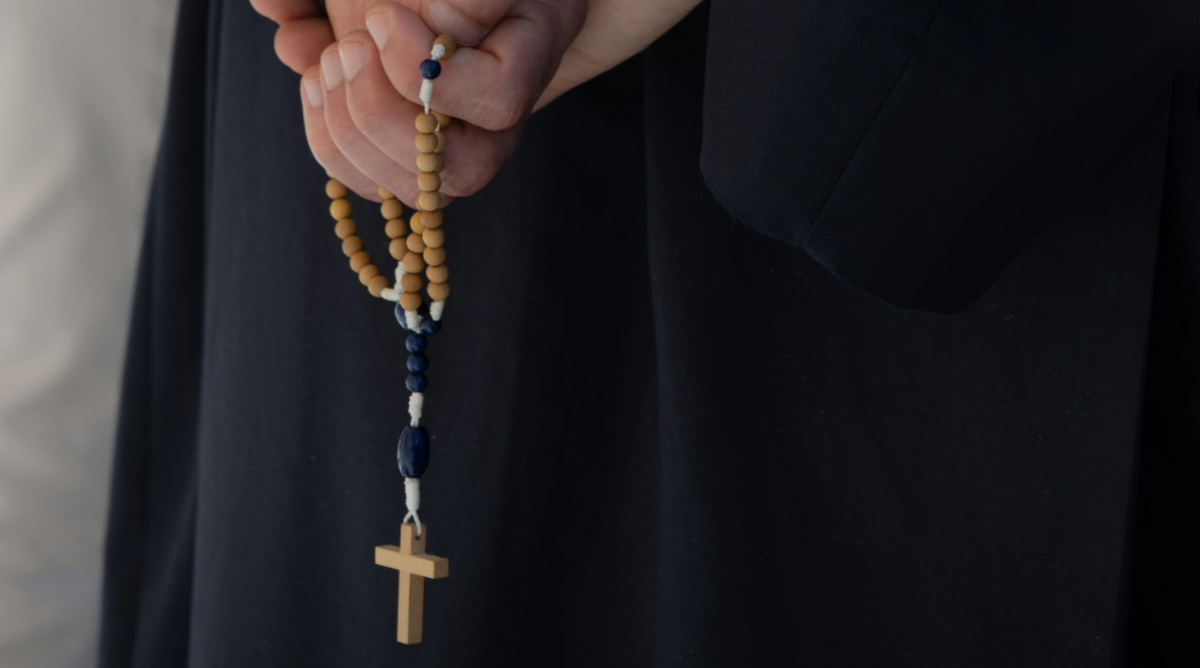
If John Paul II commanded us to “Be not afraid to open wide the doors to Christ, it is because the love of God is the great resistance movement of our time. To pray for priests is to join the resistance. A resistance movement might be reactionary at first, but as it matures, it becomes an offensive rather than defensive attitude toward conflict. Cardinal Nguyen Van Thuan observed that if we want peace, we must engage in constant struggle. Our weapons are the Mass, frequent confession, Eucharistic Adoration, the Rosary, and mental prayer. Are allies, he tells us, are our brothers and sisters in the faith, and most of all, all the saints and angels. If we do not drop our weapons and we do not betray our friends, he was convinced that victory is assured. This, in fact, is what he preached to John Paul II at one of the Holy Father’s last papal retreats. Perhaps John Paul II offers a very powerful example of how to pray for one another, especially for priests. He prayed ardently, every day, in season and out of season. His whole body shook. Groans welled up from the depths of his being. He was not afraid to pray with all of his heart. Indeed, he prayed with a profound love of the Church.
More recently, my current rector preached a homily that hammered this home for me. He argued that the Catholic faith is not a passive religion that hides from evil. Our faith follows Christ, who has shattered the gates of Hell. Indeed, the Catholic faith is a retreat into ghettos, closing its eyes and nostalgically hoping for a return to the good ole days. Christ our captain leads us through hellfire to free a host of captives. In such a gambit, loneliness is not a threat to our mission. It is not the last word. It is a consequence of the battle, an opportunity to join more deeply with the Christ who vanquishes the loneliness of hell.
If you feel drawn to join this resistance more intentionally, it is time to reinvest in your own spiritual formation because such a reinvestment will help you find a whole communion of friends ready to struggle in prayer before God with you. Spiritual formation is one of the ways to prepare ourselves for this resistance. A sort of ecclesial political decadence bogs us down into considerations far afield from the heart, and therefore, far afield from the Gospel of Christ. In a time where everyone is polarized and divided into camps, believers need to find a deeper unity in the Lord. In particular, we need to recover a depth of prayer that goes deeper than superficial psychological exercises and sentimental emotionalism. We need conversations that will help us go beyond our self-satisfied opinions and find the uncomfortable and inconvenient ground of the Cross. We need a more vital conscious awareness of the internal acts of devotion and piety over and above the battles over competing rubrics and external liturgical forms.
This means that we need much more meaningful conversations about mysteries of our faith. We need to find a way to go beyond the practicalities and controversies that normally consume our attention to find that place where heart speaks to heart, where I am dealing with the real person before me rather than a caricature of them in my imagination. Recovering better personal practices, ecclesial and spiritual awarenesses and theological conversations in the Church requires a new commitment to ongoing formation, one that is as personal as it is concerned for building up greater unity among the faithful.
A resistance movement always brings together unlikely allies. My education at Franciscan University of Steubenville opened my eyes to this realty. It was a conversation with Dr. Alice von Hildebrand my senior year that helped me connect this with the courage of my father’s family. She had shared with us Dietrich von Hildebrand’s courage in speaking out and his harrowing escape from the Nazis in Austria. It occurred to me that this happened at the same time members of my own family were involved in the Resistance. After she finished, I complained to her about how difficult the struggle of our times has become. And she smiled and explained that I should see this instead as a great grace. Where it not for the struggle, she would never have had the pleasure of meeting and encouraging my peers and me to engage in the renewal of the Church. Reflecting on this conversation, I realized that the solidarity that I saw that night around the dinner table was a reality unfolding before me now. The struggle against evil in the Church, the struggle against evil in my own heart, is permitted to forge a new solidarity of hearts, a communion of meaningful relationships, a whole new web of grace that only God’s action in the face of evil makes possible.
In my own intellectual journey, I had the privilege of being formed in the wisdom of St. Thomas but I also learned to love many other thinkers, some in different theological camps and some, not even Catholic. Even in my childhood, the martyrdom of a Russian Orthodox priest before the altar of a church just around the corner from my home parish helped me see that Eastern Christians have something important to say about prayer, including the Orthodox. At about the same time Fr. Seraphim Rose was lecturing at our town’s University and anti-Catholic though he was, he totally pegged the nihilism of our culture and the need for Christ. This is when I began to see that the “camps” we divide ourselves into are sometimes a little to restrictive. God works in many “camps,” and we must learn to work with God. My criteria became whether someone prayed and lived a life of conversion, and, most of all, whether their thought convicted me of sin. If they did, as did the Metropolitan Anthony Bloom, I would consider their ideas insofar as they conformed to the teaching of the Church.
To be continued….
__________________________________________________________________________________________________
To help us continue our mission of renewing the priesthood through encouraging and equipping priests to deepen their relationship with Christ, we invite you to consider donating to the Initiative for Priestly Renewal here.
Image: Unsplash