A Reflection from “The Silent Witness of Nazareth” by Fr. Serafino M. Lanzetta
Nothing less than a truly just man, the most righteous of men, would be fitting in order to be a worthy spouse of the Blessed Virgin. St. Joseph was indeed the most holy spouse of Mary and their marriage was a true marriage. From the Gospel accounts of Luke (1:27) and Matthew (1:16,18–21) we can deduce that at the time of the Annunciation, Mary had already been betrothed to Joseph, although they did not yet live together. The Hebrew marriage took place in two stages: the official engagement in which the two were already legally espoused and which could last up to a year, then the actual wedding which consisted in the husband’s taking of his spouse with him in cohabitation.
St. Augustine reacts against the Pelagian Julian, bishop of Eclanum, who denied the veracity of the marriage between Mary and Joseph on the grounds that it had not been consummated. St. Augustine, in response to Julian, places its essence not in the union of bodies but in the union of souls, the latter taking place with consent (fide copulatus). As the Code of Canon Law also states, the act that constitutes marriage is the consent of the engaged (can. 1057, § 1), that is, a clear manifestation of the will of both to take one another as husband and wife. In the words of the Code, “Matrimonial consent is an act of the will by which a man and a woman mutually give and accept each other through an irrevocable covenant in order to establish marriage” (can. 1057, § 2). John Paul II, in Redemptoris custos (no. 7) testifies that “Analyzing the nature of marriage, both St. Augustine and St. Thomas always identify it with an ‘indivisible union of souls,’ a ‘union of hearts,’ with ‘consent.’ These elements are found in an exemplary manner in the marriage of Mary and Joseph.” It is very beautiful to reflect on marriage as a union of hearts and souls. The truth of its essence is spiritual and not carnal. Mary and Joseph incarnated this essence in the most sublime way and therefore serve as a model for all married people.
Let us quote at greater length the great St. Augustine who, in several of his works, as Pope John Paul II reminded us, defends the truth of the marriage between Mary and Joseph. In the Contra Faustum, St. Augustine reminds us that Joseph is called Mary’s husband in that he possessed her as his spouse chastely, “not through carnal knowledge but through affection, not through the union of bodies but through that, far more precious, of souls” (23:8).
Moreover, highlighting what at first glance could cause dissonance, the Davidic genealogy of Jesus through Joseph, Mary’s spouse, and the fact that Joseph did not generate Jesus according to the flesh, Augustine asks, in the same work just cited, the following question:
Why, then, should a follower of the Gospel be disconcerted by the fact that Christ, born of the virgin Mary without any carnal union with Joseph, is nevertheless called the son of David, even though the evangelist Matthew conducts his genealogy not as far as Mary, but as far as Joseph? (23:8)
He responds by arguing that
Joseph, by virtue of manly dignity, should not be separated from the sequence of those generations, so that by this he would not seem to be separated from the woman to whom the affection of the soul united him, and that the faithful men of Christ should not believe that, in marriage, carnal union with one’s wife is so important that one is not married without it, but rather that they might comprehend that faithful spouses adhere all the more intimately to the members of Christ that they have been able to imitate Christ’s parents. (23:8)
This, then, is the reason for the exemplarity of this holy Josephine marriage. One adheres all the more to the members of Christ, to His Mystical Body, that one imitates Christ’s parents. Their profound spiritual union is the very type of the union of the members of Christ with their Head: a union that we can well define as spousal. Therefore, with Mary and Joseph, in their holy marriage, we learn to live in a spousal way above all the union with the Lord in His Body which is the Church, at which Christian marriage fundamentally aims.
This concept of the paradigmatic value of the marriage of Mary and Joseph will be taken up by St. Augustine in his work The Harmony of the Gospels:
For by this example an illustrious recommendation is made to faithful married persons of the principle, that even when by common consent they maintain their continence, the relation can still remain, and can still be called one of wedlock, inasmuch as, although there is no connection between the sexes of the body, there is the keeping of the affections of the mind. (2, 1, 2)
This marriage with Mary will be for Joseph his official entry into the mystery of God. Joseph unites himself to Mary in marriage and thus finds Jesus, becomes one with Him, to the point of becoming His father. We will return again to this spousal doctrine, which is so very central. For now, it will suffice to have introduced it in its truth and spirituality.
+
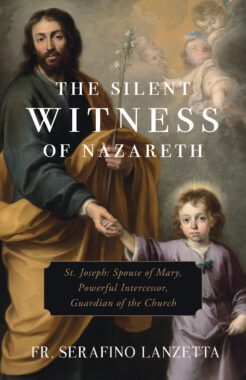
This article on the marriage of Mary and St. Joseph is adapted from the book The Silent Witness of Nazareth by Fr. Serafino M. Lanzetta which is available from Sophia Institute Press.
Art for this post on a reflection from The Silent Witness of Nazareth: cover used with permission; Photo used in accordance with Fair Use practices.