A Reflection from “Arise” by Laura Bedingfeld
Whatever Martha may have understood of Jesus’ surprising affirmations (John 11), she quickly goes to get her sister Mary, who also comes to weep at his feet. The sisters’ sorrow has something deeper in it than simply grief at the death of their brother, and Jesus is profoundly moved.
When Jesus saw her weeping, and the Jews who came with her also weeping, he was deeply moved in spirit and troubled; and he said, “Where have you laid him?” They said to him, “Lord, come and see.” Jesus wept. So the Jews said, “See how he loved him!” But some of them said, “Could not he who opened the eyes of the blind have kept this man from dying?”
Then Jesus, deeply moved again, came to the tomb; it was a cave, and a stone lay upon it. . . . And Jesus lifted up his eyes and said, “Father, I thank thee that thou hast heard me. I knew that thou hearest me always, but I have said this on account of the people standing by, that they may believe that thou didst send me.” When he had said this, he cried out with a loud voice, “Lazarus, come out.” The dead man came out, his hands and feet bound with bandages, and his face wrapped with a cloth. Jesus said to them, “Unbind him, and let him go.” (vv. 33–38, 41–44)
Knowing that he had come to raise Lazarus from the dead, why was Jesus so “deeply moved” at the sight of the tomb where his friend lay? There are several possible responses to this question.
On the one hand, “God did not make death, and he does not delight in the death of the living” (Wisd. 1:13). Jesus’ power over death does not render him immune to the sorrow and scandal that we humans instinctively feel facing death and the surrender of self or loved ones to the corrupting powers of nature. Jesus’ love for Lazarus and his sisters is replete with all the emotions of a human heart. It is also moved by sentiments of divine charity and wisdom, which recognize death as a consequence of sin.
On the other hand, despite taking no pleasure in our death, God in his love and wisdom does not ordinarily intervene to prevent it. Could he not have kept this man from dying? Yes, he could have. And this is what scandalizes us and causes many to doubt the love of God. If Jesus is deeply moved, it is surely also for this reason. He knows that many will not understand or receive the way he has chosen to prove his love for us; many will interpret his greatest act of love at the Cross as defeat and deception.
In addition to this, Jesus knows that by raising Lazarus from death, he is accepting his own death. In a very real way, raising Lazarus to life is an act of “lay[ing] down his life for his friends” (John 15:13). When the Pharisees hear of the miracle (11:46), they immediately take counsel how to put Jesus to death and give orders for his arrest (11:53, 57), reasoning that “if we let him go on thus, everyone will believe in him, and the Romans will come and destroy both our holy place and our nation” (11:48).
These orders do not seem to have done much to quell popular enthusiasm. When Jesus comes again to Bethany for a festive meal six days before the Passover (12:1–2), a “great crowd” turns out to see him, “not only on account of Jesus but also to see Lazarus, whom he had raised from the dead” (12:9). Likewise, when Jesus enters the Holy City the next day, surrounded by waving palms and cries of messianic welcome (12:12–13), it is again the miracle of Lazarus’s resurrection that draws the crowd (12:17–18). This, at last, is the promised Messiah, who has power even to raise the dead! “So the chief priests planned to put Lazarus also to death, because on account of him many of the Jews were going away and believing in Jesus” (12:10–11). The miracle of Lazarus’s resurrection is too obvious a sign of Jesus’ messianic authority, so both Jesus and Lazarus now need to be eliminated!
The resurrection of Lazarus is the ultimate sign that recapitulates not only Jesus’ theological discourses on resurrection but also his other miracles and parables of resurrection.
Like the resurrection of the widow’s son, the resurrection of Lazarus is an initiative of Jesus and takes place in full view of a crowd of unexpecting mourners, out of compassion for the dead man’s closest female relatives. Yet, like the resurrection of Jairus’s daughter, this resurrection requires an explicit cooperation of faith and an active participation on the part of the deceased’s family. He comes at their faith-filled request and is welcomed with faith, despite the provocation of an unnecessary delay. Like the faith of Jairus, their faith “if you had been here” must become faith “even now. . .” Moreover, the mourners are asked to actively participate in liberating Lazarus from the bonds of death. They have to roll away the stone from the mouth of the tomb and then unbind him when he rises.
But there is something new in this third and final resurrection miracle that is unlike the two previous ones. The dead man is already four days in the tomb. According to Jewish tradition, the “fourth day” represents the point at which the body is considered already consigned to corruption.⁵⁴ In comparison, the resurrection of the little girl and the young man were more of a reanimation, a return of the soul into a dead, but incorrupt, body. The resurrection of Lazarus, on the other hand, implies the recomposition of a body already in the process of decay. At least with respect to timing, the resurrection of Lazarus is more akin to resurrection at the Last Day, having already delayed beyond the third.
The resurrection of Lazarus is also an obvious reminiscence of the parable of Lazarus and the rich man, in which Jesus addresses an ultimate warning to the Pharisees. Now that “someone” (Lazarus) has indeed risen from the dead (Luke 16:31), they need only question this witness from beyond the grave if they are interested to know the truth about Jesus’ messianic claim.
Finally, the Gospel of John highlights the direct parallel and even causal link between the death and resurrection of Lazarus and the death and resurrection of Jesus himself. The proximity of the two events in time would have made the differences between them in certain notable particulars quite obvious. In the case of Lazarus, the stone had to be rolled away to let the dead man out. In the case of Jesus, the stone was rolled away without human hands—not to let the Risen One out but to let his disciples in. Lazarus came out of the tomb bound hands and feet, his head covered, and had to be unbound in order to regain his liberty. The burial cloths of Jesus, on the other hand, remained in the tomb undisturbed, the Risen Lord having passed through them unfettered.
+
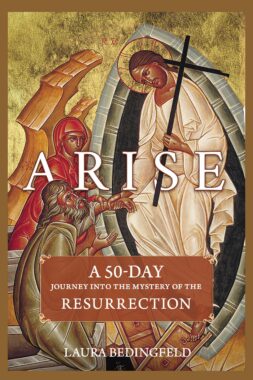
This article on resurrection symbolism is adapted from the book Arise by Laura Bedingfeld which is available from Sophia Institute Press.
Art for this post on a reflection from Arise: cover used with permission; Photo used in accordance with Fair Use practices.