The word Eucharist, which holds so much weight and significance to our faith, is from the Greek translation of the Jewish word berakah which means “giving thanks to God.” Each time the Church spreads out her banquet before us, an eternal Thanksgiving feast, I am reminded of a story my friend Kasia told me about her First Holy Communion in Poland, back in 1970.
In Poland, she said, the children received their First Communion at a special mass on Sunday, and then all that week, they would come to the evening mass at their parish and wear their white dresses and special clothes to make the whole week a celebration of that union with Christ. (What a beautiful practice, I thought, for in the ancient Jewish tradition a marriage was celebrated for a week – at the house of the bridegroom!)

Kasia smiled as she remembered rushing home after school, changing into her white dress, shaking the braids out of her hair, and donning her crown of flowers. Her friend Ania lived in the same communist-built apartment building, and together the two eight-year-olds would race down the streets of their town of Wloclawek to the Cathedral, over a mile away. Every day they arrived breathlessly at the five o’clock mass, excited but disheveled, their hair wind-blown and floral crowns slightly askew.
Many children, she remembered – including herself – had to go to these weeknight masses alone, for their parents were still at work. Both fathers and mothers worked hard in communist Poland to scratch out a meager living for their families. I had learned in George Weigel’s Witness to Hope that it was an underhanded tactic of the communist government: keep parents laboring long hours to weaken the bonds of families to each other and to the Church.
Which made me wonder. It didn’t seem to fit, this picture I had in my head, of these girls flying down the streets to mass, all in white–in a country governed by the grey clenched fist of communism. That was allowed? I asked, puzzled. They didn’t stop you?
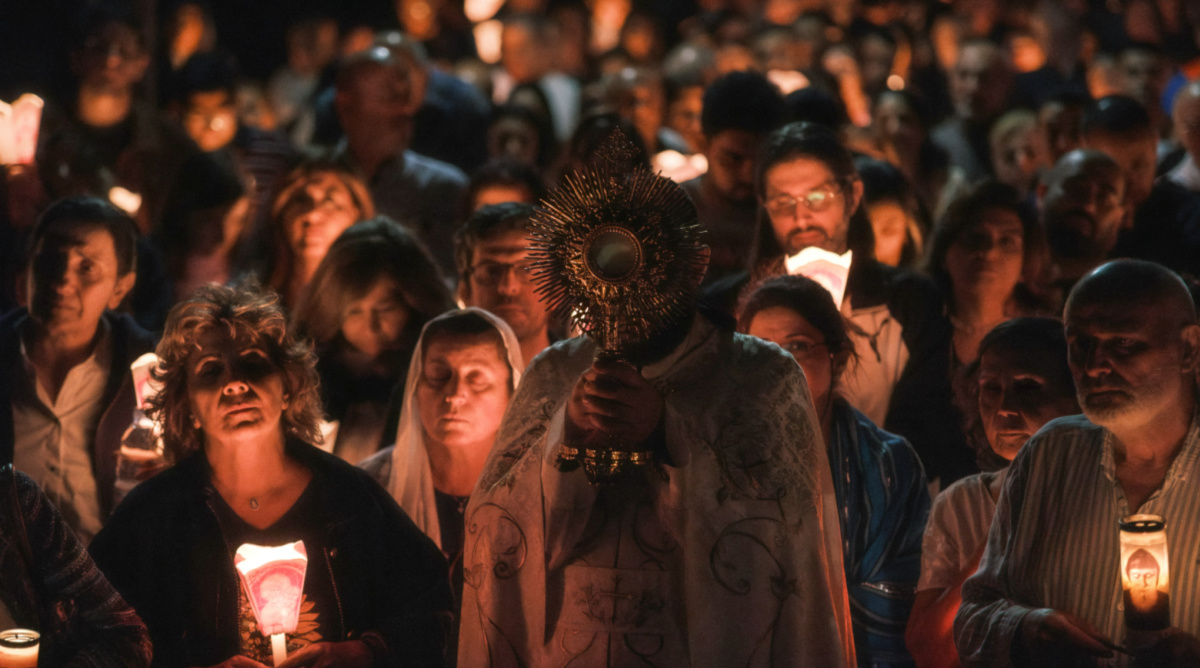
Oh no, she said. The Catholic faith and its traditions were so ingrained in the culture “they” didn’t dare openly stop it, she said. As she remembered, even the communists in her town were Catholic. And then I recalled reading, again in Witness of Hope, that when he was the archbishop of Krakow, Pope St. John Paul II would continue the annual Corpus Christ procession each spring, carrying the Eucharist through the city and preaching to tens of thousands of people in the streets. Decades later, when emboldened by their new Polish pope and then encouraged by many priests, the people became filled with optimism and hope. “We want God!” was the song sung by three million Poles during the Pope’s visit there in 1979. The government realized its efforts to make Catholicism nothing more than a sentimental fable had failed, and leaders began to fear the influence of the Church. In fact, Kasia recalled, eventually Wloclawek would have its own martyr: Blessed Jerzy Popieluszko. Fr. Popieluszko was a young priest, only 37 years old, when he was beaten to death by three Security Police officers after his anti-communist sermons, broadcast throughout Poland, became too much of a threat to the regime. His body was then thrown into the river near Wloclawek. Over 250,000 people boldly attended his funeral. (A miracle attributed to his intercession was confirmed in France in 2013 and it is expected that he will be canonized soon, as a martyr.)
But here’s why I love Kasia’s story and why it takes on meaning for us. In the middle of communist madness, in the center of a broken country, stood the solid beauty of the Church, and in the heart of the Church, a small white host. Holding everything within it. Holding Love and Hope and Joy and He who is all of those things. Veiled in white Himself, you could say. And those little girls, breathless white blurs, running to Him with abandon. To the One who anchored their country to Himself even through a century of chaos. Hearing in their eager hearts that constant call to come, come quickly, to the center of their faith – and yes, their culture, too – even as it threatened to collapse.
We in the Church now must dress in the whiteness of the confessional (for we know the result of coming to the bridal banquet improperly attired – see Matthew 22!) and run, run to Christ, without looking left or right. As the culture throws itself into flames, and freedoms begin to falter, and the things we love turn to dust and so many others are turning to pillars of salt, we have to fix our eyes on the one sure thing, the center of our existence and race to Him. And then, we hope, we’ll make it someday to the wedding banquet – which is also an eternal thanksgiving feast–a bit tousled and winded, perhaps, but in the end– arriving absolutely awestruck and among all the saints.
Several of my favorite being, in fact – Polish.
Only children, and those like them, will be admitted to the heavenly banquet. ~St. Therese of Lisieux
+
Images credit: Wikimedia Commons; photo of First Holy Communion Girl by Fr. Larry Merta, used with permission.